What the Service Includes
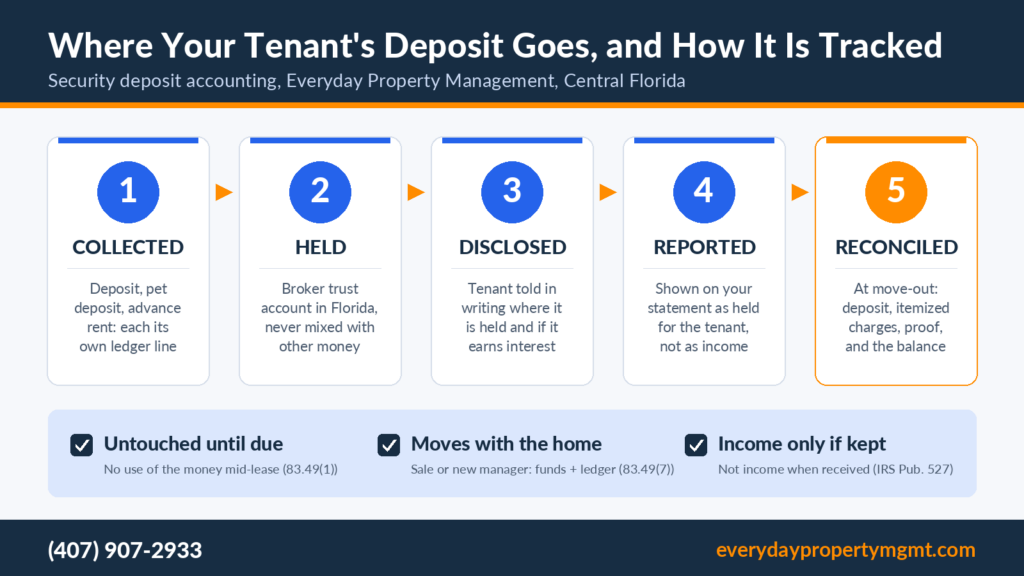
This page explains how Everyday Property Management keeps the books on tenant security deposits for owners in Seminole County, Volusia County, and the Orlando area. It is one part of our Lease Preparation & Renewals service, because the deposit terms are set in the lease. If your question is what Florida law requires of a deposit and the deadlines that apply at move-out, our Q&A on how security deposits work in a managed property answers it. This page covers the record keeping we do and what you see:
- A separate ledger for each tenant. The security deposit, any pet deposit, and any rent paid in advance are recorded as separate amounts, so each one is accounted for on its own terms.
- Trust account holding. Deposit money sits in our brokerage trust account at a Florida bank, apart from operating funds and apart from your rent.
- The tenant’s written notice. The tenant is told in writing where the deposit is held and whether it earns interest.
- Visibility on your statement. Your monthly statement shows the deposit we hold for each tenant, separate from the rent we pay out to you.
- A move-out reconciliation. One document that starts with the amount held, lists each charge with its evidence, and ends with what goes back to the tenant and what comes to you.
How Deposit Accounting Works, Step by Step
- We split the move-in money. At lease signing, the first month’s rent goes to rent, and the security deposit, pet deposit, and any rent paid beyond the next period each go to their own line on the tenant’s ledger. The amounts match what the lease says.
- We deposit it in trust. The deposit goes into our brokerage trust account and stays there. It is not used to pay for repairs, cover a slow month, or advance anything to you while the tenant is in the home.
- We put it in writing for the tenant. The tenant receives written notice of where the deposit is held and whether it earns interest, as part of the lease paperwork.
- We report it to you every month. Your statement lists the deposit balance for each tenant as money held for that tenant. It does not appear as a payment to you, because it is not yours yet.
- We reconcile it at move-out. After the move-out inspection, we compare the two condition reports, total any unpaid rent and tenant damage with photos and invoices, and prepare the reconciliation. You review the charges before any claim goes out. The tenant’s refund and any amount kept for you are paid from the trust account, and the result shows on your next statement.
The Florida Law Behind the Record Keeping
Three parts of Fla. Stat. 83.49 drive how we keep the books. Subsection (1) covers the security deposit and any advance rent beyond the next rental period, and bars mixing that money with other funds or using it “in any other way” until it is actually due. That is why the deposit never touches your operating funds. Subsection (2) sets out what the tenant’s written notice must say. Subsection (7) requires that when a property is sold or the management agent changes, the deposits move to the new owner or agent along with “an accurate accounting showing the amounts to be credited to each tenant account.” A per-tenant ledger is what makes that accounting possible on the day it is needed, whether you are hiring us, leaving us, or selling.
As a licensed broker, we are also bound by Fla. Stat. 475.25(1)(k), which requires money entrusted to a broker to be placed in a trust or escrow account at a Florida bank, credit union, or savings and loan and kept there until disbursement is properly authorized. The move-out deadlines in 83.49(3) are explained in the Q&A linked above, and we calendar each one. Statute references are to the 2026 Florida Statutes.
What You Get as the Owner, and What It Costs
Deposit accounting is included in our existing tenant management package, which is 8% of monthly rent, alongside rent collection and monthly owner statements. The full list of what each package includes is on our pricing page, and how rent itself moves from tenant to your bank is on our online rent collection and owner deposits page.
Keeping the deposit off your income line also matches how the IRS treats it. IRS Publication 527 says not to include a security deposit in income when you receive it if you plan to return it, to include any part you keep in the year you keep it, and to treat a “deposit” meant as the final month’s rent as advance rent, taxable when received. Your year-end statement and 1099 follow the same split, so your accountant can see which is which.
Frequently Asked Questions
Will I receive my tenant’s security deposit?
No. We hold it in our brokerage trust account for the whole tenancy, and your statement shows the balance. You receive only the part kept at move-out for unpaid rent or tenant damage you have reviewed.
What happens to the deposit if I sell the property or change managers?
Under Fla. Stat. 83.49(7), the deposits go to the new owner or agent with an accurate accounting of the amount credited to each tenant. Our per-tenant ledger is that accounting.
Is a security deposit taxable income?
Not when you receive it, if you plan to return it, according to IRS Publication 527. Any part you keep becomes income in the year you keep it, and a deposit meant as the final month’s rent is advance rent, taxable when received.
Want to Know Where Your Deposits Stand?
Tell us how many tenants you have and where their deposits are held today, and we will explain how we would set up the accounting. Call (407) 907-2933 to speak with Nicholas, our licensed broker, or use the form below.
General information for Florida rental owners, not legal or tax advice. For a specific deposit dispute, speak with a Florida attorney; for tax questions, speak with your accountant.