In a managed Florida rental, the property manager collects the deposit and holds it in a separate Florida account under Statute 83.49 — never mixed with other funds. At move-out, it comes back within 15 days, or a written claim notice goes out within 30 days.
How Florida Law Requires the Deposit to Be Held
Florida Statute 83.49 governs deposit money from the day it is collected. Whoever holds it — the owner or a manager acting as the owner’s agent — has three options: a separate non-interest-bearing Florida bank account, a separate interest-bearing Florida account, or a surety bond posted with the clerk of court. If the account earns interest, the tenant receives at least 75 percent of the annualized average rate or 5 percent simple interest, whichever the holder elects. Two rules are absolute: deposit money cannot be commingled with other funds, and it cannot be touched until it is actually due. Landlords or agents renting five or more units must also disclose in writing, in the lease or within 30 days, where the deposit is held and whether it earns interest.
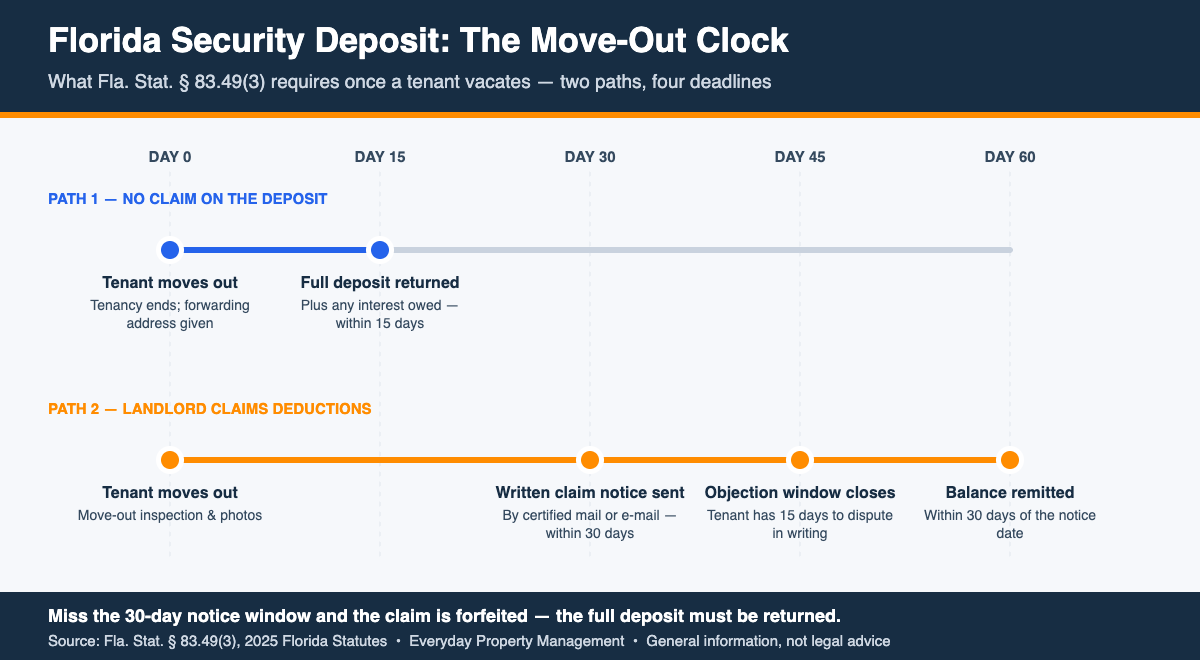
The Move-Out Clock: 15, 30, 15, 30
Once the tenancy ends, the statute runs on four deadlines. If there is no claim, the full deposit, plus any interest owed, must be returned within 15 days. If the landlord intends to keep any part of it, a written claim notice stating the amount and reason must go out within 30 days, by certified mail or — where the lease allows it — by e-mail. The tenant then has 15 days after receiving that notice to object in writing. If no objection arrives, the claimed amount is deducted and the balance remitted within 30 days of the notice date.
The teeth are in the miss: a landlord who lets the 30-day window pass forfeits the claim entirely and must return the full deposit, keeping only the right to sue for damages afterward. One duty runs the other way — a tenant leaving early owes at least seven days’ written notice with a forwarding address.
What a Property Manager Actually Does With It
The statute binds owners and managers equally; what a manager changes is execution. The deposit sits in the brokerage’s trust account, already structured for 83.49 compliance. Move-in and move-out condition reports with time-stamped photos are routine — a deposit claim is only as strong as its evidence. Deductions are itemized and limited to actual damage and unpaid amounts; normal wear and tear — faded paint, worn carpet — is not deductible, and an experienced manager will not try. Calendared deadlines keep the 30-day window from slipping past.
Two lesser-known provisions come up more than owners expect. When a property sells, or when management changes hands, the statute requires deposits, earned interest, and a per-tenant accounting to transfer to the new owner or agent. And every lease renewal legally counts as a new rental agreement, with the carried-forward deposit treated as a new deposit — so documentation is refreshed at each renewal.
Security Deposits in Orlando and Central Florida
Florida sets no cap on deposit size. In the Orlando, Seminole County, and Volusia County market, one month’s rent is the typical deposit on a single-family rental, sometimes more where pets or credit history add risk. Since 2023, state law also lets landlords offer a monthly fee in lieu of a deposit — optional for both sides.
If you are comparing property management companies near me, ask three questions: where exactly deposits are held, who documents move-in condition and how, and who sends the claim notice when a tenancy ends badly. At Everyday Property Management, deposit handling is part of full management at 8 percent of monthly rent — trust-account holding, photo-documented inspections at move-in and move-out, and every statutory notice sent on time. Tenant placement is half a month’s rent with a 12-month tenant guarantee, and lease renewals are free.
Related Questions
- How does rent collection work with a property manager?
- What happens when a tenant stops paying rent?
- Can I switch property management companies mid-lease?
- How do property managers screen tenants?
- Central Florida property management services
- Should I allow pets in my rental property?
- What records should a landlord keep for taxes?
- What happens at the end of a lease term?
Holding a Deposit and Not Sure You’re Compliant?
Tell us where the deposit sits today and when the lease ends, and we will walk you through exactly what Statute 83.49 requires — no charge, no obligation. Call (407) 907-2933 or use the form below.
General information for Florida rental owners, not legal advice. Statute references are to the 2025 Florida Statutes. For a specific dispute or lease, speak with a Florida landlord–tenant attorney.