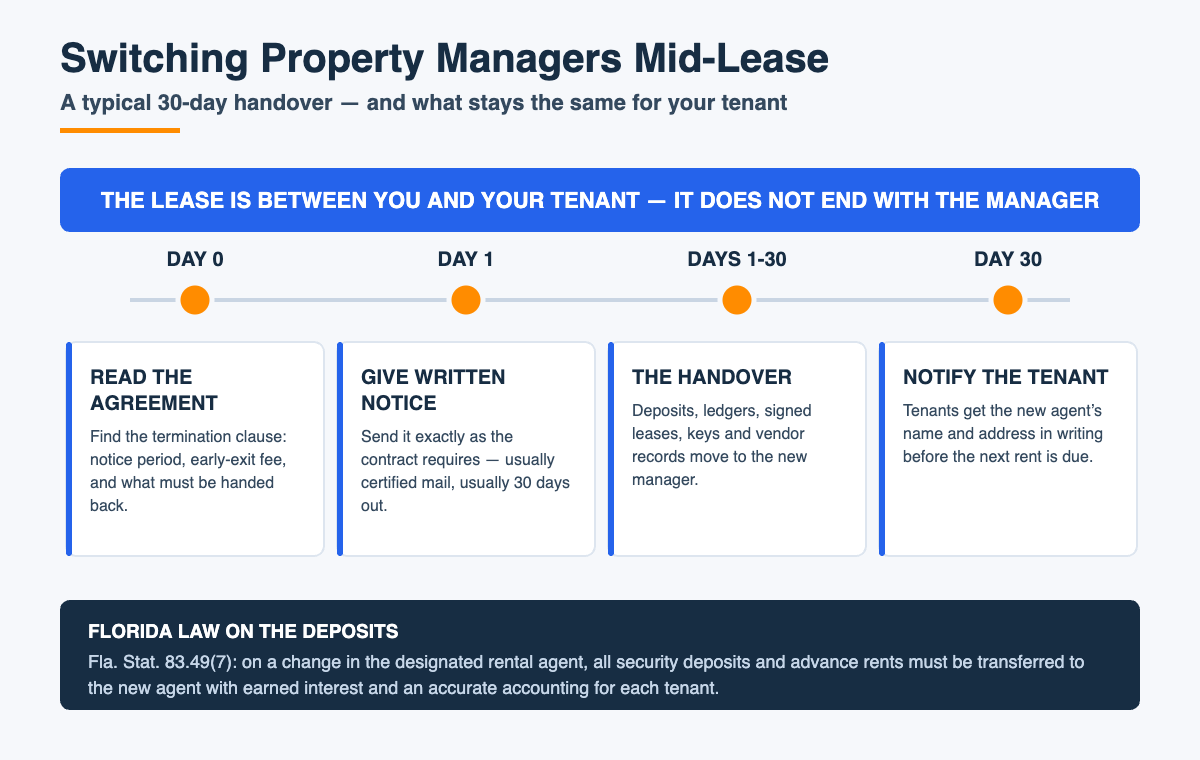
Yes. Your lease is with you, not your management company, so changing managers mid-lease does not disturb your tenant’s tenancy. What governs the switch is your management agreement — usually a 30-day written notice — and Florida law requiring deposits, records and a full accounting to transfer to the new agent.
The Lease Doesn’t Change — Only Who Manages It
Florida’s Residential Landlord and Tenant Act defines the “landlord” as the owner or lessor of the dwelling unit (section 83.43(3), Florida Statutes). Your property manager is your agent, not the landlord. The lease your tenant signed binds you and your tenant, and it keeps running on its original terms — same rent, same end date, same renewal option — no matter who collects the money each month. Your tenant cannot treat the change as grounds to break the lease, and you cannot use it to rewrite one.
That is the misconception most owners bring to this question: they assume they are locked in until the tenancy ends. They are not. What locks them in, if anything, is the management agreement they signed with the company — a separate contract, on its own timetable.
What Your Management Agreement Actually Controls
Pull the agreement out and find four things before you do anything else.
The termination clause. Most Florida management agreements let either party cancel on 30 days’ written notice, and many specify exactly how that notice must be delivered. Certified mail is common, and an email will not satisfy a certified-mail clause. Some agreements are cancellable only “for cause” during an initial term, or renew automatically unless notice lands inside a narrow window.
The early-termination fee. This may be a flat amount, the management fees remaining on the current lease term, or a percentage of rent. It is negotiable far more often than owners expect, particularly where service failures are documented in writing.
The leasing or “tail” clause. Some agreements say that if the tenant the company placed stays in the home, a placement or renewal fee is still owed after management ends. Read this one twice — it is usually where the real money sits.
Exclusivity and listing rights. Check whether the company retains any right to re-list or sell the property, and whether the marketing photographs and listing copy belong to you or to them.
What Has to Be Handed Over
Florida is specific about the money. Under section 83.49(7), Florida Statutes, upon a change in the designated rental agent, all security deposits and advance rents held for tenants must be transferred to the new agent, together with any earned interest and an accurate accounting showing the amount credited to each tenant. Once those funds and records are transferred and a written receipt is given, the outgoing agent is released from the duty to hold that money. There is a rebuttable presumption that the new agent received the deposit — but the statute limits that presumption to one month’s rent, which is exactly why the written receipt and the per-tenant accounting matter.
Beyond the deposits, ask for the full file: signed leases and addenda, applications and screening results, the complete rent ledger and payment history, move-in inspection reports and photographs, every key, remote and access code, open work orders, appliance warranties, vendor contacts, HOA correspondence, and year-to-date income and expense statements with the 1099 detail. If the outgoing company is a licensed Florida brokerage, section 475.5015 requires it to preserve brokerage records for at least five years from the date funds were received or the management agreement was executed — so “we no longer have that” is rarely a complete answer.
Telling Your Tenant
Section 83.50, Florida Statutes, requires the landlord — or a person authorized to act on the landlord’s behalf — to disclose in writing the name and address of the person authorized to receive notices and demands, and that person keeps that authority until the tenant is notified otherwise. In practice that means one clear letter or email to the tenant before the next rent is due, naming the new manager, the new address for notices, and the new way to pay rent.
If the deposit itself moves to a different account or depository, section 83.49(2) requires written notice to the tenant within 30 days of the change, stating the name and address of the new depository and whether the tenant earns interest. That particular notice duty applies to landlords renting five or more dwelling units, but a competent manager sends it either way — a tenant who does not know where the deposit sits is a dispute waiting to happen. Handled properly, the whole exchange should run manager-to-manager with you copied, not owner-to-tenant in a panic.
Switching Property Managers in Orlando, Seminole & Volusia County
Before you sign with anyone new, verify the licence. Leasing and managing property for compensation in Florida is real estate activity, so the company should operate under an active broker’s licence. Ask for the broker of record by name, then check it yourself on the Florida DBPR licensee search. Ask, too, whether tenant deposits will sit in a separate Florida escrow account and who reconciles it.
Then think about timing. A switch is cleanest at a natural seam — a lease renewal, a scheduled inspection, or the first of a month — and messiest in the middle of an eviction, an insurance claim, or a major repair, where a gap in the paper trail costs real money. Owners across Orlando, Seminole County and Volusia County should also confirm the incoming manager genuinely services their municipality and knows its inspection and registration rules; advertised coverage areas are often wider than actual ones.
One last practical note if you have been searching for a property manager near me because the current company has gone quiet: ask the two questions that predict service better than any brochure. What is your average response time to an owner email, and how many properties does each manager carry? At Everyday Property Management full management is 8% of monthly rent, tenant placement is half a month’s rent with a 12-month tenant guarantee, and lease renewals are free — and we run the handover with your previous company so you do not have to.
Related Questions
- How much does a property management company charge?
- What does a property manager actually do?
- Is hiring a property manager worth it for a single rental?
- Who pays for repairs in a managed rental property?
- Our Central Florida property management services
- How do security deposits work in a managed property?
- What’s included in a property management agreement?
- How does rent collection work with a property manager?
Thinking About Making the Switch?
Tell us the property address and when your current agreement renews, and we will read the termination clause with you, map out the handover, and give you a straight answer on what it costs to move. Most owners are managed by us within 30 days of the notice going out. Call (407) 907-2933 or send the form below.
General information for Florida rental owners, not legal advice. Statute references are to the 2025 Florida Statutes; for a specific dispute, speak with a Florida attorney.