What the Service Includes
This page explains how Everyday Property Management documents the condition of a rental at the start and end of a tenancy for owners in Seminole County, Volusia County, and the Orlando area. It is one part of our Maintenance & Repairs service. If your question is how many times a year a rental should be inspected and what Florida’s entry rules allow, our Q&A on how often a rental property should be inspected answers that. This page covers the two inspections that bracket a tenancy and what they produce:
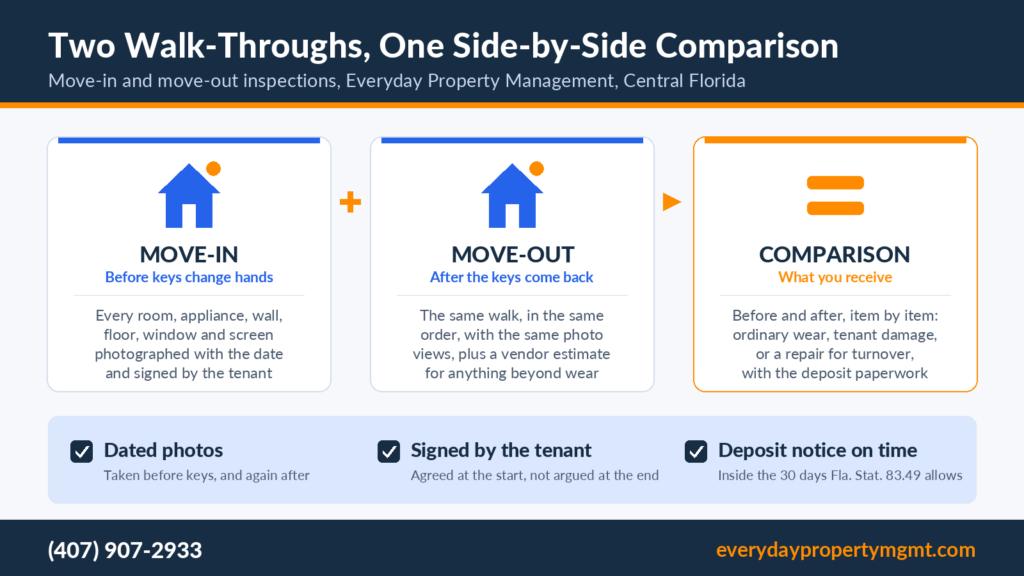
- A move-in condition report. Every room, appliance, wall, floor, ceiling, window, screen, and fixture, plus the exterior and yard where they are part of the lease, with date-stamped photos of each.
- The tenant’s signature. The tenant reviews the report, adds anything we missed, and signs it.
- A move-out inspection in the same order. After the tenant’s belongings are out and the keys are back, we repeat the walk room by room and photograph the same views.
- A side-by-side comparison. Each finding is marked as ordinary wear, tenant damage, or a repair the next tenant should not inherit, with the before and after photo next to each other.
- The deposit paperwork and the repair handoff. Tenant damage goes into the written deposit claim; repair items become work orders for our maintenance team so the home is ready to list again.
How the Two Inspections Work, Step by Step
- We walk the home before keys change hands. Once the lease is signed and any make-ready work is finished, we record the condition of each room, down to scuffs, nail holes, and the state of the appliances.
- The tenant reviews and signs. The tenant gets the report at key handover and is asked to report anything the walk missed right away, so it is added to the record rather than argued about later.
- The report becomes the baseline. It is stored with the lease and is the reference point for any mid-lease visit.
- Move-out expectations go to the tenant. When notice is given, the tenant is told what we expect at handover: the home emptied and cleaned, keys returned, and a forwarding address for the deposit accounting.
- We walk it again. Within days of the keys coming back, we repeat the inspection in the same order and photograph the same views. Anything beyond ordinary wear is sent to a vendor for a repair estimate.
- We compare, decide, and send the paperwork. Ordinary wear is not charged to the tenant. Tenant damage is itemized with the photo and the estimate or invoice behind it, and the deposit is either returned or the written claim notice goes out inside the deadlines below. You receive the full comparison report.
- Repairs become turnover work orders. Items the next tenant should not inherit go to our vendor network as part of make-ready and turnover coordination, and the invoices land in your owner portal like any other job.
The Florida Law the Reports Are Built For
The reason a move-in report matters is a deadline. Under Fla. Stat. 83.49(3)(a), a landlord who does not intend to claim any of the deposit must return it within 15 days after the tenancy ends. A landlord who does intend to claim part of it must, within 30 days, send the tenant written notice, by certified mail to the last known mailing address (or by e-mail if both parties signed an e-mail notice addendum under Fla. Stat. 83.505), stating the intention to impose a claim and the reason. A landlord who misses that 30-day notice forfeits the right to impose the claim on the deposit. That is why the evidence has to exist before the tenant moves in, not be reconstructed afterward. Our Q&A on how security deposits work in a managed property walks through where the deposit is held and every deadline that follows the notice.
Neither of these two inspections depends on the entry rules in Fla. Stat. 83.53: the move-in walk happens before the tenant has possession, and the move-out walk happens after the keys are returned. Any inspection during the tenancy does rely on that section, and the notice it requires is covered on the Q&A linked above.
What You Get as the Owner, and What It Costs
Our pricing page lists “Detailed walk-through inspections with photo documentation” inside the Tenant Placement Package, whose one-time leasing commission is half a month’s rent. The move-out walk-through and the deposit accounting that follows are part of the Existing Tenant Management Package at 8% of monthly rent. Neither inspection appears as a separate line item. Repairs found at move-out are billed by the vendor at the vendor’s price, with no markup from us, the same way every job on our maintenance dispatch page is handled.
What you hold at the end is a matched pair of dated, photographed reports and an itemized comparison. If a tenant objects to a deduction, that file is the answer.
Frequently Asked Questions
When does the move-in inspection take place?
After the lease is signed and any make-ready work is complete, and before the tenant receives keys. The tenant then reviews and signs the report and can add anything the walk missed.
What is the difference between ordinary wear and tenant damage?
Ordinary wear is the gradual change that comes from living in a home as intended, such as lightly worn carpet in a hallway or faded paint. Damage is a specific change the tenant caused or allowed, such as a hole in a door, a burn on a counter, or a pet stain. Only damage is itemized against the deposit, and each item carries its before and after photo.
What happens if the move-out comparison shows damage?
We price the repair, itemize it with the photos, and send the tenant the written claim notice by certified mail within the 30 days that Fla. Stat. 83.49(3)(a) allows. You receive the full comparison report and the vendor estimates or invoices behind each item.
Want a Condition Report You Can Rely On?
Tell us about your property and we will show you what a move-in report looks like and how the move-out comparison reaches you. Call (407) 907-2933 to speak with Nicholas, our licensed broker, or use the form below.