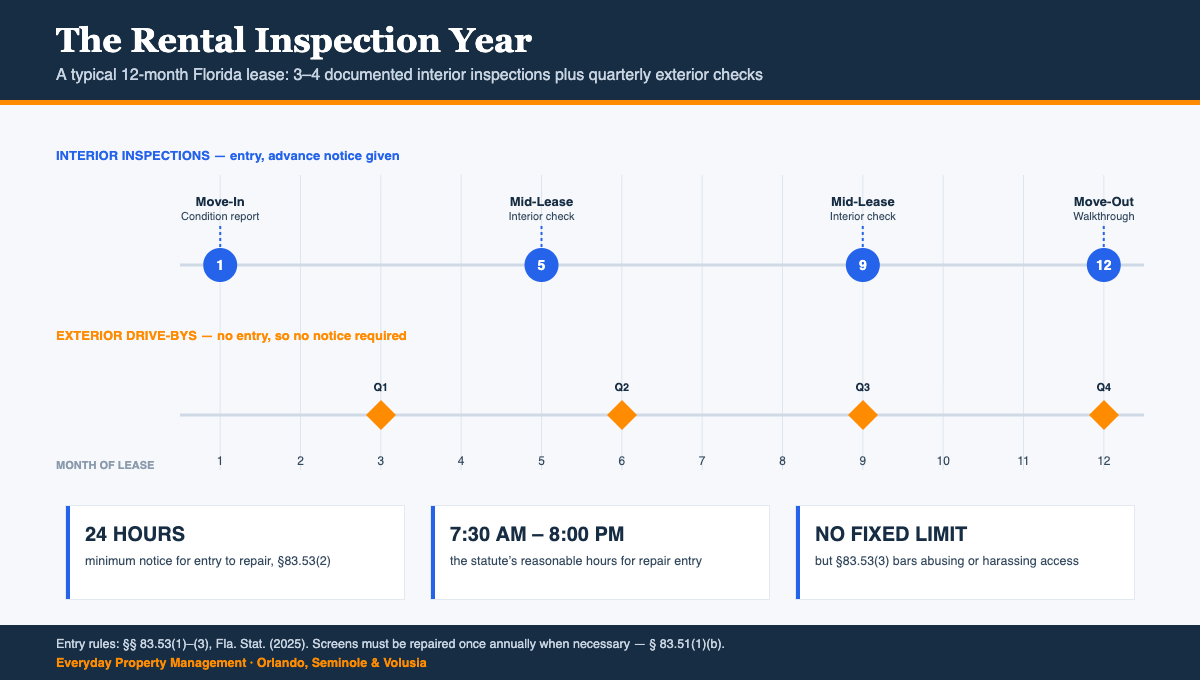
Short answer: Most rental homes should be inspected three to four times a year: at move-in, once or twice mid-lease, and at move-out, plus exterior drive-bys. Florida sets no inspection schedule, but section 83.53 requires reasonable notice before entry — at least 24 hours where the visit is for repairs.
The Four Inspections Every Rental Needs
A workable schedule has four moving parts, and only one of them surprises most owners.
Move-in. A documented condition report with date-stamped photos of every room, appliance, wall and floor, signed by the tenant. It is the most valuable document you will ever hold on that property, because it is the baseline every security deposit claim is measured against.
Mid-lease interior. Once or twice during a 12-month lease, typically around month five and again near month nine. This is where you catch a slow supply-line leak, a failing water heater, an unauthorized pet or occupant, or an air handler backing up through a clogged drain line while it is still a small repair.
Move-out. The same walkthrough as move-in, compared side by side. That comparison is what turns a deposit deduction into a defensible one.
Exterior drive-bys. Cheap, fast, and requiring no notice at all because nobody enters the home. Quarterly is normal. You are looking for lawn neglect, unregistered vehicles, roof and fascia damage, and anything likely to draw an HOA or code-enforcement letter.
What Florida Law Says About Entering to Inspect
Florida gives owners a clear right of access, with limits. Under section 83.53(1), Florida Statutes, a tenant “shall not unreasonably withhold consent” to the landlord entering from time to time to inspect the premises, make repairs, supply agreed services, or show the home to prospective buyers or tenants.
Two details trip owners up. First, the well-known 24-hour rule is narrower than most people think. Section 83.53(2) defines reasonable notice as at least 24 hours, and a reasonable time as between 7:30 a.m. and 8:00 p.m., specifically for the purpose of repair. For an inspection the statute instead lists the circumstances allowing entry: with the tenant’s consent, in an emergency, when consent is unreasonably withheld, or when the tenant has been absent for half a rental period. In practice, careful managers apply the 24-hour written notice standard to every non-emergency visit, because it is the cleanest way to show the entry was reasonable.
Second, section 83.53(3) states that the landlord “shall not abuse the right of access nor use it to harass the tenant.” There is no numeric cap anywhere in the statute. The ceiling is reasonableness, and it gets judged after the fact.
How Often Is Too Often?
Monthly interior inspections of a tenant who pays on time and reports problems are hard to justify and are a reliable way to lose a good renter. Three to four documented visits a year, on notice and for a stated purpose, sits comfortably inside both the statute and ordinary practice. Escalate only when something warrants it: a late-payment pattern, a neighbor complaint, a maintenance request hinting at a larger problem, or the run-up to a renewal decision.
Why Central Florida Rentals Need a Tighter Rhythm
Climate does most of the arguing here. Central Florida stays humid nearly year-round, so an HVAC condensate line that would be a nuisance elsewhere turns into damaged drywall and a mold claim within weeks. Atlantic hurricane season runs June 1 through November 30, which makes a pre-season exterior check of the roof, soffits, gutters, overhanging limbs and window seals worth considerably more in Orlando, Seminole County and Volusia County than a calendar-neutral schedule implies.
State law reinforces the rhythm. Section 83.51(1)(b) requires a landlord to ensure screens are installed in reasonable condition at the start of the tenancy and, after that, to repair screen damage once annually when necessary. That is an explicitly yearly duty, and it only gets met if somebody actually looks. Section 83.51(2)(b) separately requires working smoke detection devices at the commencement of a single-family or duplex tenancy. Insurers add a cadence of their own: Florida carriers commonly ask for a four-point inspection covering roof, electrical, plumbing and HVAC on older homes, and offer premium credits for a wind mitigation inspection. Neither is a landlord-tenant requirement, but both influence who walks your property and when.
If you are comparing property management companies near me, ask two concrete questions: how many documented inspections are included in the management fee, and what you actually receive afterward — a written report with photographs, or a phone call. At Everyday Property Management, full management is 8% of monthly rent, tenant placement is half a month’s rent with a 12-month tenant guarantee, and lease renewals are free.
Related Questions
- Who pays for repairs in a managed rental property?
- What does a property manager actually do?
- What’s included in a property management agreement?
- How much does a property management company charge?
- Rental maintenance and repairs in Florida
- How do property managers handle emergency repairs?
- What is a reasonable maintenance reserve for a rental?
- What insurance does a rental property owner need?
- Our move-in and move-out inspections
Not Sure When Your Rental Was Last Inspected?
Send us the property address and the lease start date, and we will map out a sensible inspection schedule for that specific home — how many visits, in which months, what notice goes to the tenant, and exactly what report you get back afterward. Call (407) 907-2933 or use the form below.
General information for Florida rental owners, not legal advice. Statute references are to the 2025 Florida Statutes; for a specific lease, speak with a Florida attorney.