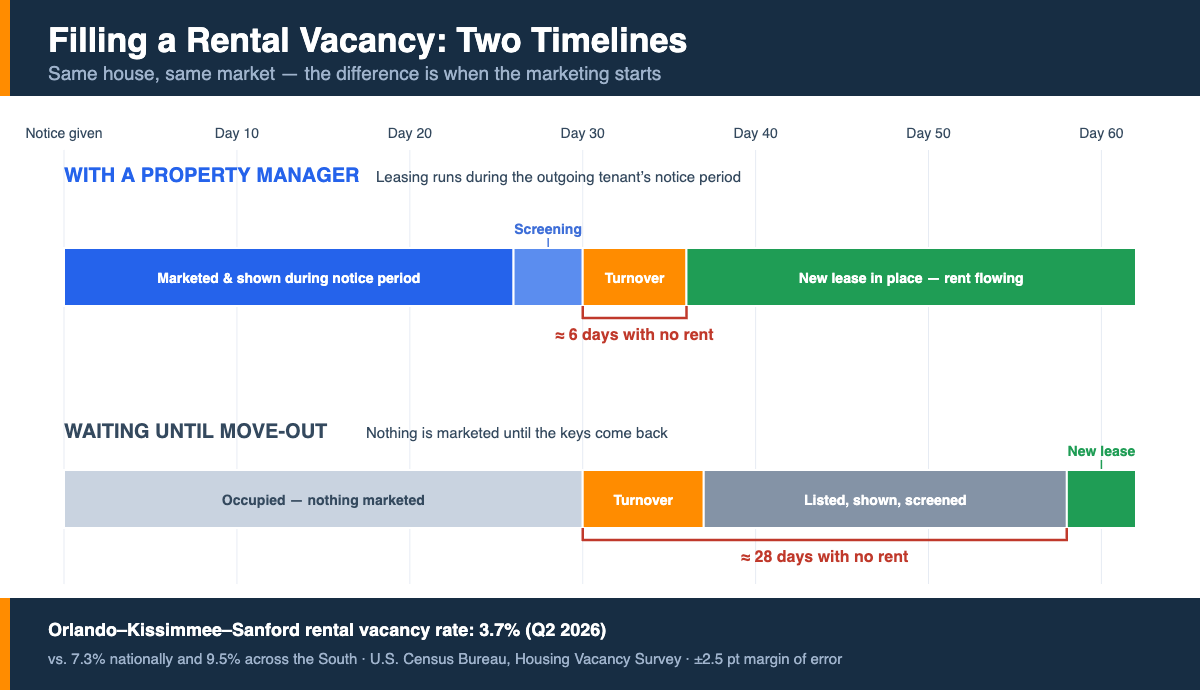
The Two Clocks: Days on Market vs. Days Vacant
There are two numbers here, and owners routinely conflate them. Days on market is how long a listing sits before a lease is signed. Days vacant is how long the property produces no rent at all. They are not the same figure, and only one of them shows up on your bank statement. A home can take three weeks to lease and still lose only a few days of rent — or lease in a single week and still sit empty for a month, if nobody started marketing until the outgoing tenant handed back the keys.
Professional managers work the second number, and the lever is the notice period. Under section 83.575 of the Florida Statutes, a fixed-term lease may require between 30 and 60 days’ notice before the end of the term, and if it obliges the tenant to give notice it must also oblige the landlord to give notice of non-renewal. A month-to-month tenancy requires 30 days’ notice under section 83.57(3). That window is a head start: it tells the manager the home is coming available while someone is still paying rent for it. Section 83.53(1) then makes the head start usable — a tenant may not unreasonably withhold consent to the landlord entering to exhibit the home to prospective tenants.
What Happens Between Notice and Keys
A typical managed turn runs like this. Within a day or two of notice, the manager pulls a rent analysis, books photography, and syndicates the listing to Zillow, Apartments.com, the MLS and the company’s own site. Showings begin immediately, scheduled around the current tenant. Applications come in, and screening — income verification, credit, criminal and eviction history, and prior-landlord references — commonly takes one to three business days when an applicant’s documents are complete. The lease is signed electronically and the start date is set to line up with the turnover work.
That turnover work is usually the only genuine vacancy. Cleaning, touch-up paint, carpet and any deferred repairs typically need three to seven days on a standard single-family home, longer if flooring or a full repaint is involved. Florida’s access rules explain the sequencing: entry to make repairs requires at least 24 hours’ notice and must fall between 7:30 a.m. and 8:00 p.m. under section 83.53(2), while showings run on the consent standard in 83.53(1). In practice a manager can market hard during the notice period, but heavy repair work waits for an empty house.
What Actually Slows a Vacancy Down
Price, nearly always. A home listed five to ten percent above what comparable properties are actually leasing for will generate showings and no applications — and every week it sits costs roughly a quarter of a month’s rent, usually far more than the reduction that would have leased it in week one. The second most common cause is slow response. Leasing inquiries arrive at all hours and go cold within a day, so reply time moves the needle more than advertising spend does.
After that, the usual suspects: thin or badly lit photos, no floor plan or 3-D tour, a restrictive pet policy in a market where most applicants have pets, visible deferred maintenance, and owner-imposed limits on when the home can be shown. Screening standards set well above the market will also stall a property — but loosening them is the wrong correction, because a weak tenant is far more expensive than an extra vacant week. The right correction is pricing and presentation, so that a strong applicant pool shows up in the first ten days.
How Fast Rentals Move in Orlando, Seminole & Volusia County
Central Florida is currently a landlord-favourable market by the official numbers. The U.S. Census Bureau’s Housing Vacancy Survey put the rental vacancy rate for the Orlando–Kissimmee–Sanford metro at 3.7% in the second quarter of 2026, down from 6.6% in the first quarter — comfortably under the 7.3% national rate and the 9.5% rate across the South, and far below Tampa–St. Petersburg–Clearwater at 10.5%. Metro-level estimates come from a small sample and carry a margin of error of roughly ±2.5 points, so read them as direction rather than precision. The direction is clear enough: correctly priced homes around Orlando are not sitting.
Timing still matters locally. Leasing demand across Orlando, Seminole County and Volusia County peaks from late spring through summer, when school calendars and relocations line up, then slows from Thanksgiving through January. A lease that expires in December is worth steering toward a spring expiration at renewal — a short extension now is often worth more than a rent increase. The cheapest vacancy, of course, is the one that never happens, which is why we handle lease renewals at no charge. And if you have been searching for a property manager near me to shorten your turnaround, ask one straight question: when does marketing start, and what did the last ten homes actually lease for against asking?
Related Questions
- How do property managers screen tenants?
- What does a property manager actually do?
- Who pays for repairs in a managed rental property?
- Is hiring a property manager worth it for a single rental?
- Our Central Florida property management services
- How is rental price determined for my property?
- Should I allow pets in my rental property?
- When can a landlord raise the rent?
- Our 12-month tenant placement guarantee
Let’s Get Your Rental Leased — Not Just Listed
Marketing starts the day notice comes in, not the day the keys come back. Tenant placement is one-half of one month’s rent, backed by a 12-month tenant guarantee; full management is 8% of monthly rent, and lease renewals are free. Call (407) 907-2933 or send us your property details below and we’ll come back with a rent estimate and a realistic leasing timeline.