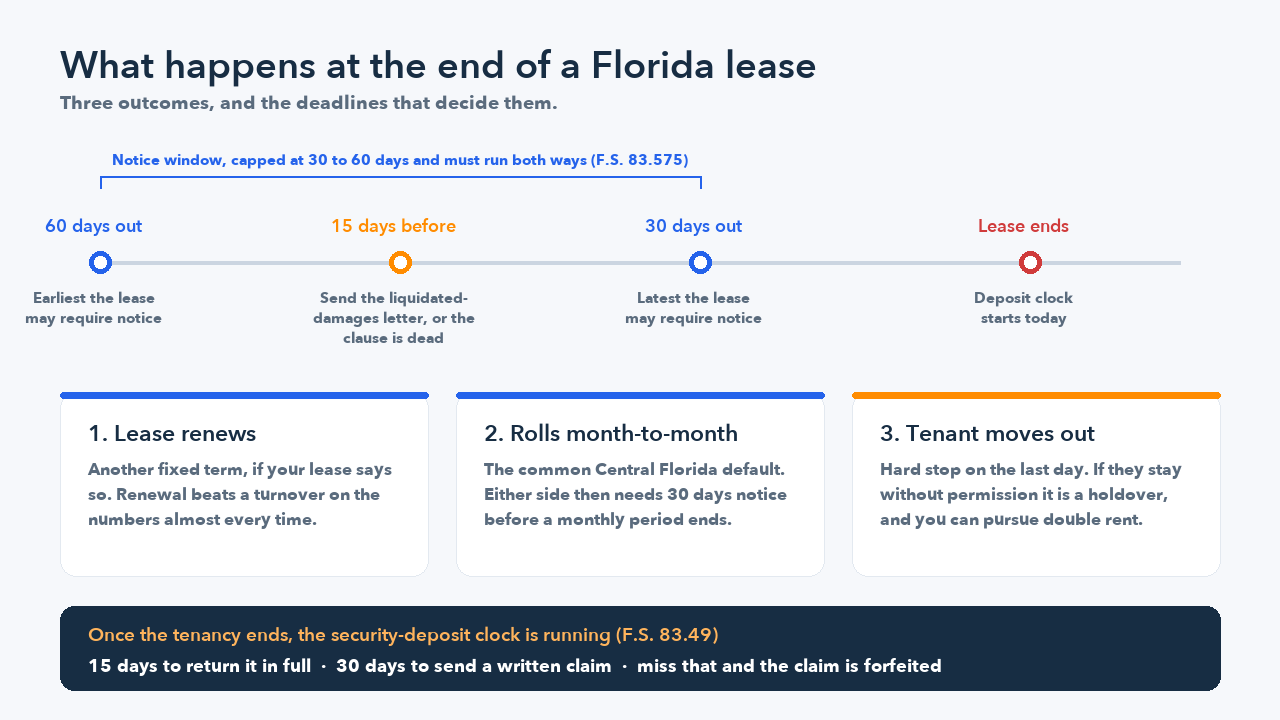
One of three things: the lease renews, it rolls into a month-to-month tenancy, or the tenant moves out. Which happens by default is written into your lease, not into Florida law. If the lease requires notice of non-renewal, that notice must run between 30 and 60 days, and it must go both ways.
Your lease decides the default, not the statute
Florida law does not renew leases and does not end them for you. Three defaults are common, and yours is whichever one your lease says: auto-renewal for another fixed term unless someone gives notice, automatic conversion to month-to-month, which is the most common arrangement in Central Florida, or a hard stop where the tenancy simply ends on the last day.
A surprising number of self-managing owners discover which one they have only after the term has run out. Read it in month nine, not month twelve.
The notice rules under Florida Statute 83.575
A fixed-term lease may require the tenant to give notice before vacating at the end of the term, but only if it also requires the landlord to tell the tenant, within that same window, that the lease will not be renewed. The obligation is symmetrical by law, so a clause that binds only the tenant is not enforceable as written.
The window is capped at both ends: no less than 30 days and no more than 60 days from either party. A 2025 amendment added a delivery requirement, so the landlord’s non-renewal notice must be given in the manner prescribed by s. 83.56(4), which means mailing or hand delivery, not a text message.
The liquidated-damages trap
If your tenant fails to give the required notice, the lease can charge liquidated damages, but only if you did one thing first. Under s. 83.575(2), the landlord must send the tenant written notice, in that same 83.56(4) manner, within 15 days before the notice period starts, spelling out the tenant’s notice obligation, the termination date, and every fee, penalty and charge that applies.
Skip that letter and the clause is dead. This is the single most commonly forfeited right at lease-end in Florida, and it is lost purely on calendar management, which is exactly the kind of thing a manager’s system catches and a busy owner’s memory does not.
If the tenant stays on
With your permission, the tenancy becomes month-to-month. Either side can then end it with at least 30 days’ written notice before the end of a monthly period under s. 83.57(3), raised from 15 days in 2023. And under s. 83.575(3), a tenant who stays with permission and does not give that notice owes you an additional month’s rent.
Without your permission, it is a holdover. Section 83.58 lets you pursue possession through the eviction process and recover double the rent for the period the tenant refuses to surrender the unit.
The deposit clock starts immediately
The day the tenancy ends, s. 83.49(3)(a) starts running: 15 days to return the deposit in full if you are making no claim, 30 days to send written notice of a claim by certified mail to the last known address or by e-mail where permitted, and then the tenant has 15 days to object.
Miss the 30-day deadline and you forfeit the claim entirely. You can still sue for damages, but only after returning the whole deposit first. Move-out inspections and photographs are worth little if the notice goes out on day 31.
How this works in Orlando, Seminole and Volusia
One point is worth knowing, because a lot of Central Florida advice online is out of date: since July 1, 2023, Florida Statute 83.425 preempts local governments from setting their own residential notice requirements. Orange County’s rental-notices ordinance and similar local rules are no longer enforceable on these questions. The statewide 30 to 60 day framework applies in Orlando, Seminole County and Volusia County alike, so you do not need three different lease-end procedures for three counties.
What does vary locally is the economics. A turnover in our market means a vacancy, a make-ready and a new placement fee. Against that, a modest renewal increase almost always wins. We start renewal conversations roughly 90 days out, comfortably ahead of any 60-day notice window, so the decision is made on numbers rather than on a deadline. Lease renewals are free under our management agreement.
Related Questions
- When can a landlord raise the rent?
- How do security deposits work in a managed property?
- How often should a rental property be inspected?
- What is included in a property management agreement?
- Full-service property management services
Talk to a Local Property Manager
Everyday Property Management tracks every lease-end date for Orlando, Seminole County and Volusia County owners, so the notices go out on time and the renewal conversation happens early. Call (407) 907-2933 or send us a message below.
This page is general information, not legal advice. Specific situations turn on your lease language. Talk to a Florida attorney about your situation. Last reviewed September 17, 2026.