What the Service Includes
This page explains how Everyday Property Management works alongside an eviction attorney once a case has to go to court, for owners in Seminole County, Volusia County, and the Orlando area. It is one part of our Eviction Coordination & Legal Notices service, and it picks up where our Florida 3-day notice service ends. If your question is whether a property manager can run an eviction without a lawyer at all, our Q&A on whether property managers handle evictions answers it. This page covers the working relationship once counsel is involved:
- A decision point, not an automatic filing. When the notice deadline passes, we tell you where things stand and you decide whether to proceed.
- A complete case file. Everything the attorney needs, gathered from our own records so you are not hunting for paperwork.
- One channel for the tenant side. Payment offers, move-out promises, and tenant messages go to counsel and to you, so nothing said at the door undercuts the case.
- Updates you can follow. Filing, service, any hearing date, judgment, and the writ, reported to you as each one happens.
- Writ day and the turnover after it. Meeting the sheriff, rekeying, handling what was left behind, and getting the home ready to rent again.
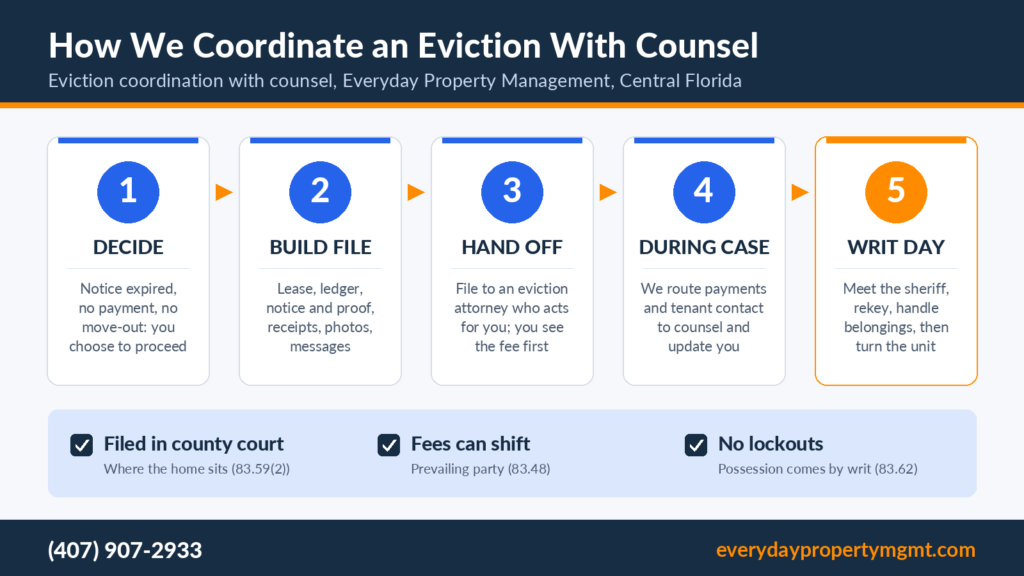
How We Coordinate With Counsel, Step by Step
- We bring you the decision. When the notice deadline passes with no payment and no move-out, we send you the ledger balance, any partial payments or promises the tenant made, and what filing will involve. Nothing goes to an attorney until you say so.
- We build the file. The signed lease and any addenda, the rent ledger from our online rent portal, the notice with its dated proof of service, receipts for any partial payment, the move-in inspection photos, and the written messages exchanged with the tenant. We also confirm how the property is titled, because an LLC owner changes who can appear for you.
- We hand it to counsel. The attorney represents you as the landlord, not us. Before anything is filed you receive the attorney’s fee and the filing costs, so you approve the cost of the case with the numbers in front of you.
- We keep the tenant side running through counsel. While the case is open, any payment offer, move-out date, or request from the tenant is passed to the attorney and to you before we respond. We keep up routine management of the home in the meantime, including maintenance requests.
- We report each milestone. You hear from us when the complaint is filed, when the tenant is served, if a hearing is set, and when judgment is entered.
- We handle writ day and the turnover. After the sheriff posts the writ, we coordinate the time, meet the deputy, change the locks, and deal with belongings left in the home. From there the unit moves into our make-ready and turnover coordination.
The Florida Law Behind the Handoff
Under Fla. Stat. 83.59(2), the landlord, the landlord’s attorney, or the landlord’s agent files the complaint for removal in the county court of the county where the home sits, and the landlord is entitled to the summary procedure of section 51.011. The same subsection says an agent who is not an attorney may take no action beyond the initial filing of the complaint. That is why a contested case runs through counsel, and why step 3 hands the whole file over rather than part of it.
Fla. Stat. 83.48 allows the prevailing party in an action to enforce the rental agreement to recover reasonable attorney fees and court costs from the other side, and the lease cannot waive that right. A fee award is a judgment, not a guarantee of payment, so we budget the case with you as though the costs are yours.
Writ day is governed by Fla. Stat. 83.62. After judgment, the clerk issues a writ directing the sheriff to put the landlord in possession after 24 hours’ notice posted on the premises. At or after that point, the landlord or the landlord’s agent may move the tenant’s personal property to or near the property line, and the landlord may ask the sheriff to stand by to keep the peace while the locks are changed, at an hourly rate paid by whoever asks. Until then the locks stay as they are. Statute references are to the 2026 Florida Statutes.
What You Get as the Owner, and What It Costs
Counsel coordination is part of “Eviction Coordination: notices, legal documentation, and counsel coordination,” listed in the Existing Tenant Management Package on our pricing page at 8% of monthly rent. Our part of the work is not billed as a separate item. The clerk’s filing and service fees, the sheriff’s charges, and the attorney’s fee are costs of the case, and you approve them before filing. For how a nonpayment case moves from late rent to the writ, our Q&A on what happens when a tenant stops paying rent lays out the timeline.
What you hold at the end is a case file your attorney did not have to assemble, a record of every update, and a home that goes straight from the sheriff’s writ into turnover instead of sitting while someone works out what happens next.
Frequently Asked Questions
Who does the eviction attorney represent?
You, the owner. The attorney acts for the landlord, and we coordinate between you, the attorney, and the tenant. You approve the attorney’s fee and the filing costs before the case is filed.
Can I accept rent from the tenant once the case is filed?
Ask your attorney first, because accepting money during a case can affect it. We pass every payment offer to counsel and to you before anything is accepted.
What happens to the tenant’s belongings on writ day?
Under Fla. Stat. 83.62(2), at or after execution of the writ the landlord or the landlord’s agent may move the tenant’s personal property to or near the property line, and the landlord may ask the sheriff to stand by while the locks are changed. We coordinate that with the deputy and document the condition of the home.
Facing an Eviction That Needs Counsel?
Tell us the property address, the date rent was last received, whether a notice has been served, and how the home is titled, and we will explain how the handoff to counsel would run for your property. Call (407) 907-2933 to speak with Nicholas, our licensed broker, or use the form below.
General information for Florida rental owners, not legal advice. For a specific lease or eviction, speak with a Florida attorney.