What the Service Includes
This page explains the reports Everyday Property Management prepares for owners in Seminole, Volusia, and the Orlando area. It is one part of our Rent Collection & Accounting service. The collection side, from the tenant portal to your direct deposit, is covered on our online rent collection and owner deposits page. This page covers the paperwork that comes out of it:
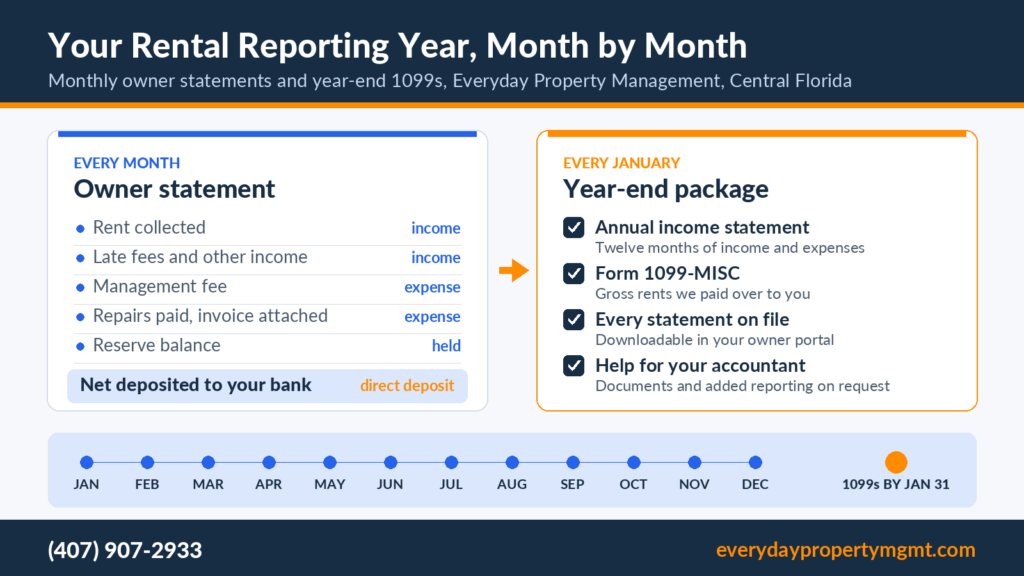
- A monthly owner statement. Income, expenses, and account balances for each property, with payment history and a year-to-date summary.
- Supporting documents. Repair invoices are attached to the month they were paid, so each expense on the statement has its receipt next to it.
- 24/7 owner portal access. Current and past statements and records can be downloaded any time, not only when we send them.
- A year-end package. An annual financial summary of the full year, plus the Form 1099 we are required to issue for the rent we collected on your behalf.
- Accountant support. If your CPA needs documentation or a report beyond the standard package, we work with them directly.
How Your Reporting Year Works, Step by Step
- Onboarding. When you sign the management agreement we collect a Form W-9 from you, so the year-end 1099 carries your correct legal name and taxpayer identification number. If you own through an LLC, the W-9 should be in the name the IRS knows that LLC by.
- Each month closes. After rent is collected and approved bills are paid, the month’s ledger is reconciled and your statement is issued alongside your deposit.
- You review it. Each line is labeled as income, expense, or reserve. If a charge looks wrong, call us and we walk through the invoice behind it.
- The year closes. After the December statement, the twelve months are combined into an annual income statement that totals rent, other income, management fees, and repairs for the year.
- Your 1099 is issued. We furnish your Form 1099-MISC by January 31 and file it with the IRS, and a copy is posted to your owner portal with the annual statement.
- Tax season. You or your accountant use the annual statement and the 1099 together. Questions go to us, and we answer from the ledger.
Why the 1099 and Your Deposits Show Different Numbers
This is the question owners ask most in January. The 1099 reports the gross rents we collected and paid over to you. Your deposits are net: the management fee, repairs, and any reserve top-up were paid out of rent first. So the 1099 is usually larger than the total of your twelve deposits.
That is not a mistake, and it does not mean you are taxed on money you never received. The annual income statement lists every one of those expenses, and your accountant reports the gross rent and deducts the expenses on your return. Matching the two documents is the reason we prepare them as a set.
The Rules Behind the Reports
The 1099 is a federal requirement. The IRS Instructions for Forms 1099-MISC and 1099-NEC say a tenant who pays rent to a property manager does not report it, but the property manager must use Form 1099-MISC to report the rent paid over to the property owner. For 2026 the reporting threshold for rents is $2,000, and the form must be furnished to you by January 31.
The monthly statement answers to Florida law. Under Fla. Stat. 475.25(1)(d)1, a broker who fails to account for or deliver money at the time agreed upon faces discipline, and your management agreement sets that time. Fla. Stat. 475.5015 requires a broker to keep the books, accounts, and records of the brokerage business for at least 5 years from the date money is received, so a statement you need years from now can still be produced.
What You Get as the Owner, and What It Costs
Our pricing page lists the Existing Tenant Management Package at 8% of monthly rent, and names “annual income statements and 1099s included” and “direct deposit with monthly income statements” as part of it. The pricing page lists no separate charge for statements, the year-end package, or the 1099.
These reports cover the rental activity we handle. Mortgage interest, insurance you pay yourself, property tax bills, and your purchase documents stay with you. For the full list of what a landlord should keep and for how long, read our Q&A on what records a landlord should keep for taxes. This page is general information, not tax advice.
Frequently Asked Questions
What is on a monthly owner statement?
Rent and other income collected, the management fee, each repair paid with its invoice, the reserve balance, and the net amount deposited to your bank, with payment history and a year-to-date summary. Every statement is downloadable in your owner portal.
When will I receive my 1099?
By January 31, which is the IRS deadline for furnishing Form 1099-MISC. It arrives with your annual income statement, and a copy is posted to your owner portal.
Why is my 1099 higher than the money I received?
The 1099 reports gross rents, before the management fee and repairs were paid from them. Your annual income statement lists those expenses so your accountant can deduct them.
Want Reports Your Accountant Can Work From?
Send us the property address and we will show you a sample owner statement before you commit. Call (407) 907-2933 to speak with Nicholas, our licensed broker, or use the form below.