Most Central Florida landlords should reserve 1% to 2% of the property’s value each year — roughly $3,000 to $6,000 on a $300,000 rental — or about $1 per square foot. Separately, your property manager holds a smaller working reserve, typically $300 to $500, for routine repairs.
The Three Rules of Thumb — and Where Each One Fails
Three shortcuts circulate, and none is wrong so much as incomplete.
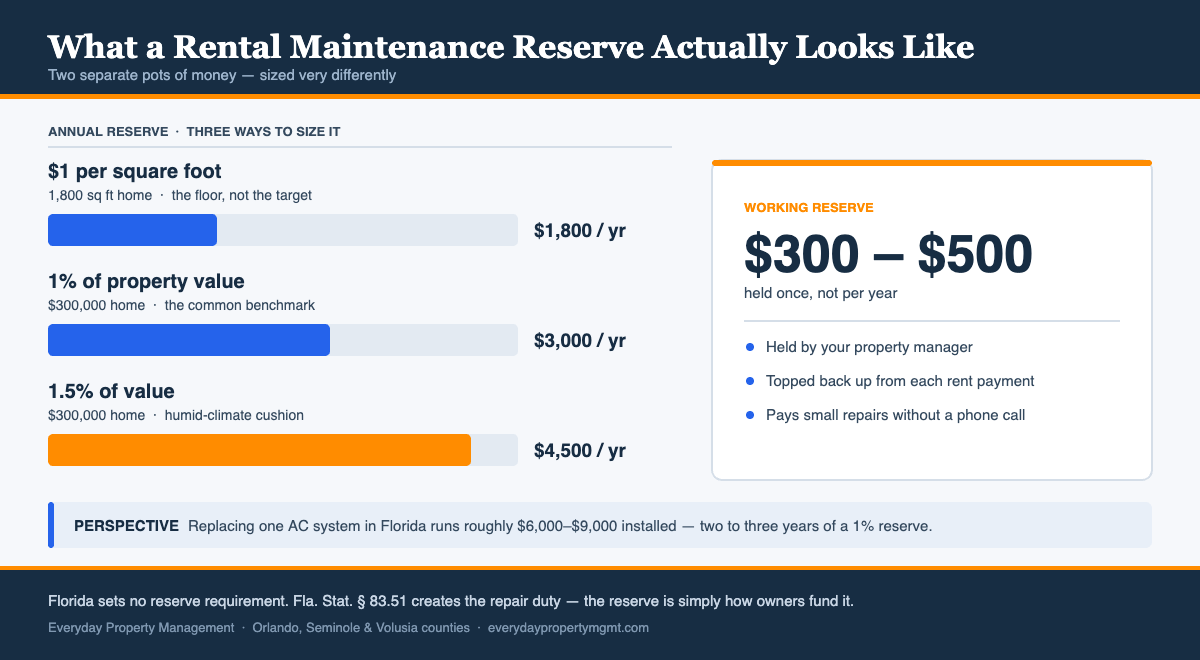
One percent of property value per year. On a $300,000 rental that is $3,000 annually. It is the most quoted figure because it scales with the thing that drives repair cost — the size and quality of the house. Its weakness is that it tracks market value, and Florida market values have moved for reasons that have nothing to do with the age of your water heater.
One dollar per square foot per year. An 1,800-square-foot home gets $1,800. This one ignores value entirely and prices the building instead. Treat it as a floor rather than a target; on anything past fifteen years old it is usually too thin.
Fifty percent of gross rent. The widest of the three, and the most often misquoted. The 50% rule covers all operating expenses — taxes, insurance, management, vacancy and maintenance together — not maintenance alone. Cited as a maintenance reserve, it overstates the number badly.
Take the highest of the three, not the average. They disagree most on exactly the properties where getting it wrong hurts most.
The Second Reserve Your Property Manager Holds
Owners are often surprised to find two different reserves in play, doing two different jobs. The annual reserve above is yours; it accumulates in your account so that a $7,000 air handler is a planned expense rather than an emergency.
The working reserve is something else. Nearly every management agreement asks the owner to leave a small float with the manager — commonly $300 to $500 per unit — held in the firm’s trust account and topped back up out of each month’s rent. It is not a fee — it is your money, returned when the agreement ends. Its only job is speed: when a tenant reports a leaking supply line on a Saturday, the manager can dispatch a plumber against the float instead of waiting for you to answer the phone.
Most agreements pair that float with an approval threshold — the dollar figure above which the manager must reach you first. Read the two numbers together. A $500 reserve with a $500 threshold behaves very differently from a $500 reserve with a $150 threshold.
How to Size Your Own Number
Start at 1% and adjust for the four things that actually predict spend.
Age. Under ten years old, 1% is usually generous. Past twenty, 1.5% to 2% is realistic.
Systems already on the clock. Roof, HVAC, water heater and electrical panel are the four items large enough to break a year’s budget on their own. If one is within five years of the end of its life, reserve toward its replacement cost directly instead of a percentage.
Turnover and grounds. Make-ready between tenants — paint, carpet, cleaning, lock changes — is maintenance, and it arrives in one lump. A pool or an HOA landscaping standard adds a recurring line the percentage rules do not see.
Then sanity-check the balance against the largest single thing that can fail. If your reserve would not cover a full system replacement today, the percentage is still a budgeting exercise rather than a safety net.
Why Central Florida Reserves Should Run Higher
Florida law sets the frame but never the number. Section 83.51, Florida Statutes, requires a landlord to comply with applicable building, housing and health codes — or, where none apply, to keep the roof, windows, doors, floors, steps, porches, exterior walls, foundations and other structural components in good repair, and the plumbing in reasonable working condition. Nothing in the statute tells you to hold a reserve. The duty it creates is why you need one.
Then the climate does the arguing. Air conditioners that last fifteen years in a milder state commonly last ten to twelve here, because humidity above 70% keeps them running most of the year, and replacement typically runs $6,000 to $9,000 installed. That single line item is why 1% so often proves thin in Central Florida. Hurricane season, June 1 through November 30, puts roofs, soffits and fascia under load every year, and higher carrier deductibles push more of that damage onto the owner rather than the policy.
For an Orlando, Seminole County or Volusia County rental, 1.5% of value is a more defensible starting point than 1%, and any home with an original roof or an aging air handler should be reserving toward that specific replacement rather than a percentage.
If you are comparing property management companies near me, ask three concrete questions: what the working reserve is, what the approval threshold is, and whether you receive itemized vendor invoices or a single line on a statement. At Everyday Property Management, full management is 8% of monthly rent, tenant placement is half a month’s rent with a 12-month tenant guarantee, and lease renewals are free.
Related Questions
- Who pays for repairs in a managed rental property?
- What’s included in a property management agreement?
- How often should a rental property be inspected?
- How much does a property management company charge?
- Rental maintenance and repairs in Florida
- How do property managers handle emergency repairs?
- What insurance does a rental property owner need?
- What records should a landlord keep for taxes?
Not Sure What Your Rental Should Be Reserving?
Send us the property address, the year it was built, and the age of the roof and air handler, and we will put a specific annual reserve figure against that specific home — not a rule of thumb. Call (407) 907-2933 or use the form below.
General information for Florida rental owners, not legal or financial advice. Statute references are to the 2025 Florida Statutes; cost ranges are market estimates and vary by property. For a specific lease or budget, speak with a Florida attorney or your accountant.