A property management agreement should spell out ten things: the parties and the property, the term and how it renews, the exact scope of services, every fee, your repair-approval limit and reserve, how rent and deposits are held in escrow, when you get paid and reported to, insurance and indemnity, the termination clause, and the broker’s license.
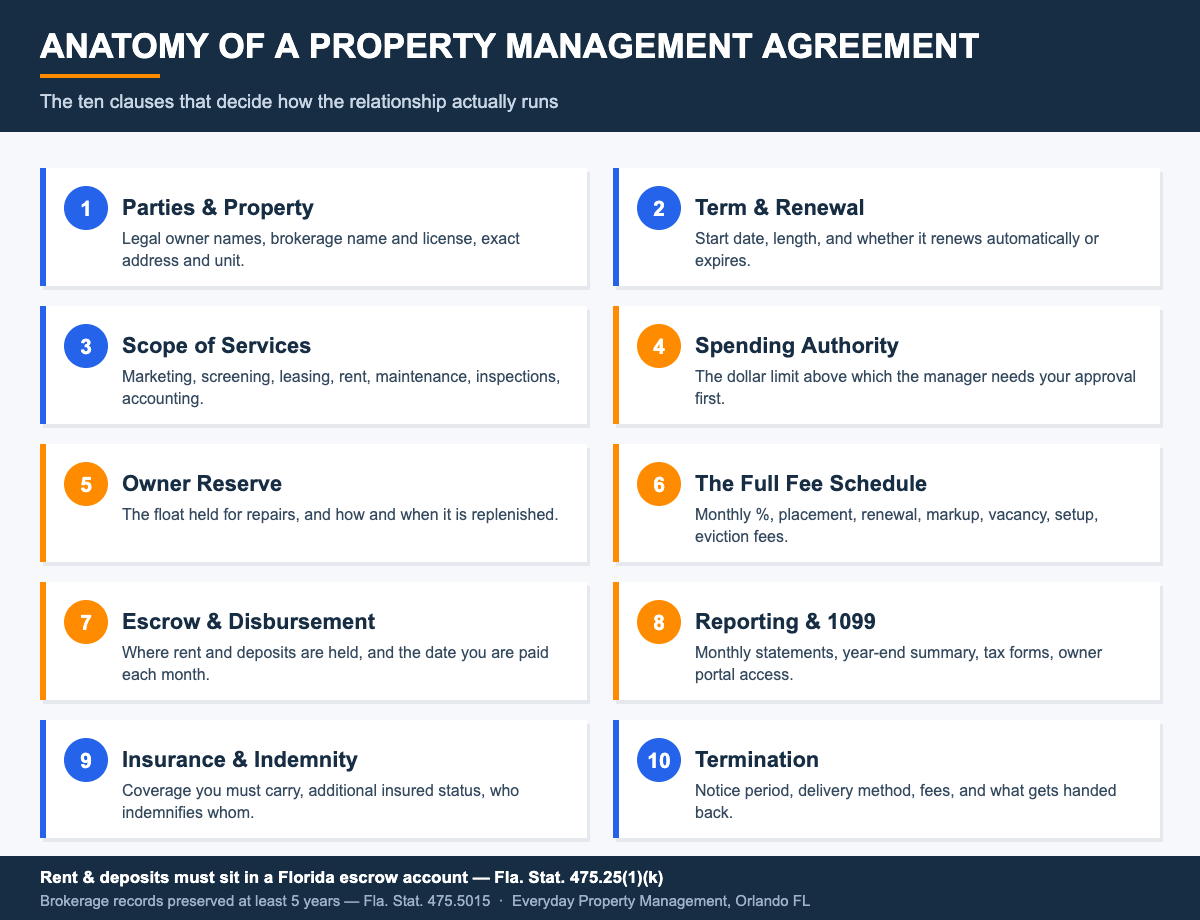
The Ten Clauses That Do the Work
Your management agreement is a contract with a real estate brokerage, and Florida law leaves most of its terms to negotiation. That makes the document — not the statute — the thing that decides how your rental is actually run. Ten clauses carry almost all of that weight.
- Parties and property. The owner’s name as it appears on the deed, the brokerage’s legal name and license number, and the exact address and unit.
- Term and renewal. When it starts, how long it runs, and whether it renews on its own.
- Scope of services. Marketing, screening, lease preparation, rent collection, maintenance coordination, inspections, monthly accounting, statutory notices and eviction filings — and, in the useful versions, what is not included.
- Spending authority. The dollar threshold above which your manager needs your approval before spending your money, plus the emergency exception for the burst pipe at midnight.
- Owner reserve. The float the brokerage holds to pay for repairs, and how it is topped back up.
- Fees. All of them, in one table.
- Money handling. Where rent and deposits sit, and the date your proceeds land.
- Reporting. Monthly statements, a year-end summary, your 1099, and owner portal access.
- Insurance and indemnity. The coverage you must carry, whether the brokerage is named as an additional insured, and who indemnifies whom.
- Termination. Notice period, how notice must be delivered, any fee, and what gets handed back.
Where Your Money Sits: Florida’s Escrow and Records Rules
Florida is unusually specific about this half of the agreement. Under section 475.25(1)(k), Florida Statutes, a broker must immediately place, upon receipt, any money entrusted to them in escrow with a title company, banking institution, credit union or savings and loan located and doing business in this state, where the funds stay until disbursement is properly authorized. The same paragraph lets a broker keep up to $5,000 of brokerage funds in a property management escrow account — a cushion for bank charges, not a blurred line. Section 475.25(1)(v) puts the duty to review the brokerage’s trust accounting procedures on the broker personally.
So your agreement should name the depository, state plainly that rent and tenant security deposits are held in a Florida escrow or trust account, and commit to a disbursement date. “Owner proceeds are remitted by the 10th” is a term you can hold someone to. “Funds are remitted monthly” is not.
Records matter as much as money. Section 475.5015 requires a broker to preserve brokerage books, accounts and records for at least five years from the date entrusted funds were received — or, where no funds were entrusted, five years from the execution of a rental property management agreement — and for two years after any related litigation concludes. Your agreement should never promise less than that.
The Fees That Aren’t the Monthly Percentage
The monthly management fee is the number every owner compares. The rest of the schedule is where agreements actually diverge:
- Tenant placement or leasing fee, charged when a new tenant signs
- Lease renewal fee — commonly a quarter to half of one month’s rent
- Maintenance markup or coordination fee added to contractor invoices
- Vacancy fee charged while the home sits empty
- Setup or onboarding fee at the start of the relationship
- Inspection fees beyond whatever number is included
- Eviction coordination and court-appearance charges
- The late-fee split — whether late fees paid by the tenant go to you or to the manager
- Early termination fee
Ask for the schedule as one table, then ask what a normal year costs on your specific property. A low headline percentage sitting on top of a leasing fee, a renewal fee, a markup and a vacancy fee is not a low fee.
Term, Termination and the Broker’s License
Most Florida management agreements run twelve months and then renew. Read the renewal mechanics closely: an agreement that renews automatically unless you cancel inside a narrow window is a very different commitment from one with a fixed end date. There is a useful benchmark here. Section 475.25(1)(r) requires every written listing agreement to carry a definite expiration date, a description of the property, price and terms, the fee, and the principal’s signature — and it forbids any provision requiring the owner to notify the broker of an intention to cancel after that date. Because most management agreements also grant the brokerage authority to advertise and lease the home, ask for the same discipline in the management agreement itself.
The termination clause should also say what comes back. On a change in the designated rental agent, section 83.49(7) requires all security deposits and advance rent held for tenants to transfer to the new agent together with any earned interest and an accurate accounting showing the amount credited to each tenant. Leases, ledgers, applications, inspection photographs, keys and access codes belong on that list too.
Then check the license. Leasing or managing property for someone else for compensation is real estate brokerage activity in Florida, and operating as a broker without a valid, current, active license is a third-degree felony under section 475.42(1)(a). Ask for the broker of record by name and verify it yourself on the Florida DBPR licensee search before you sign. Worth knowing, too: Florida’s brokerage-relationship disclosure requirements in section 475.278 are written for residential sales, and by the statute’s own terms they do not apply to the rental or leasing of real property unless an option to purchase a property of four or fewer residential units is given. No standard state form is going to arrive and explain what your manager owes you — the agreement is the only place it is written down. Finally, section 83.50 requires written disclosure of the person authorized to receive notices and demands from the tenant; your agreement should say who that is, so a three-day notice never lands at the wrong address.
Signing a Management Agreement in Orlando, Seminole & Volusia County
Central Florida adds a few local wrinkles worth writing into the document. If the home sits in an HOA or condominium association, the agreement should say who handles association approval of your tenant, who pays the application fee, and who answers violation letters — that approval alone can add two to three weeks to a move-in around Orlando, and associations here are not shy about fines. Confirm as well that the manager will handle any municipal rental registration and genuinely services your city rather than the whole region.
Insurance is the other Central Florida item. Ask what coverage the agreement obliges you to carry, whether the brokerage must be named as an additional insured, and how storm damage is handled — who authorizes emergency mitigation, who documents it for the claim, and what happens to your spending limit when a named storm is in the forecast. An agreement that is silent on hurricanes gets tested eventually.
If you have been comparing property management companies near me and every proposal reads the same, ask each company for its actual agreement rather than the brochure, and compare the four clauses that vary most: spending limit, renewal fee, late-fee split and termination. At Everyday Property Management, full management is 8% of monthly rent, tenant placement is half a month’s rent with a 12-month tenant guarantee, and lease renewals are free — and our agreement is written to be read in one sitting.
Related Questions
- How much does a property management company charge?
- What does a property manager actually do?
- Can I switch property management companies mid-lease?
- Who pays for repairs in a managed rental property?
- Our Central Florida property management services
- How do property managers handle emergency repairs?
- What is a reasonable maintenance reserve for a rental?
- What insurance does a rental property owner need?
Want to Read an Agreement That Makes Sense?
Send us the property address and we will walk you through our management agreement clause by clause — the spending limit, the reserve, the fee schedule and the way out — before you sign anything. If you already have an agreement with another company, we are happy to read it with you and point out what to ask about. Call (407) 907-2933 or use the form below.
General information for Florida rental owners, not legal advice. Statute references are to the 2025 Florida Statutes; for a specific agreement or dispute, speak with a Florida attorney.