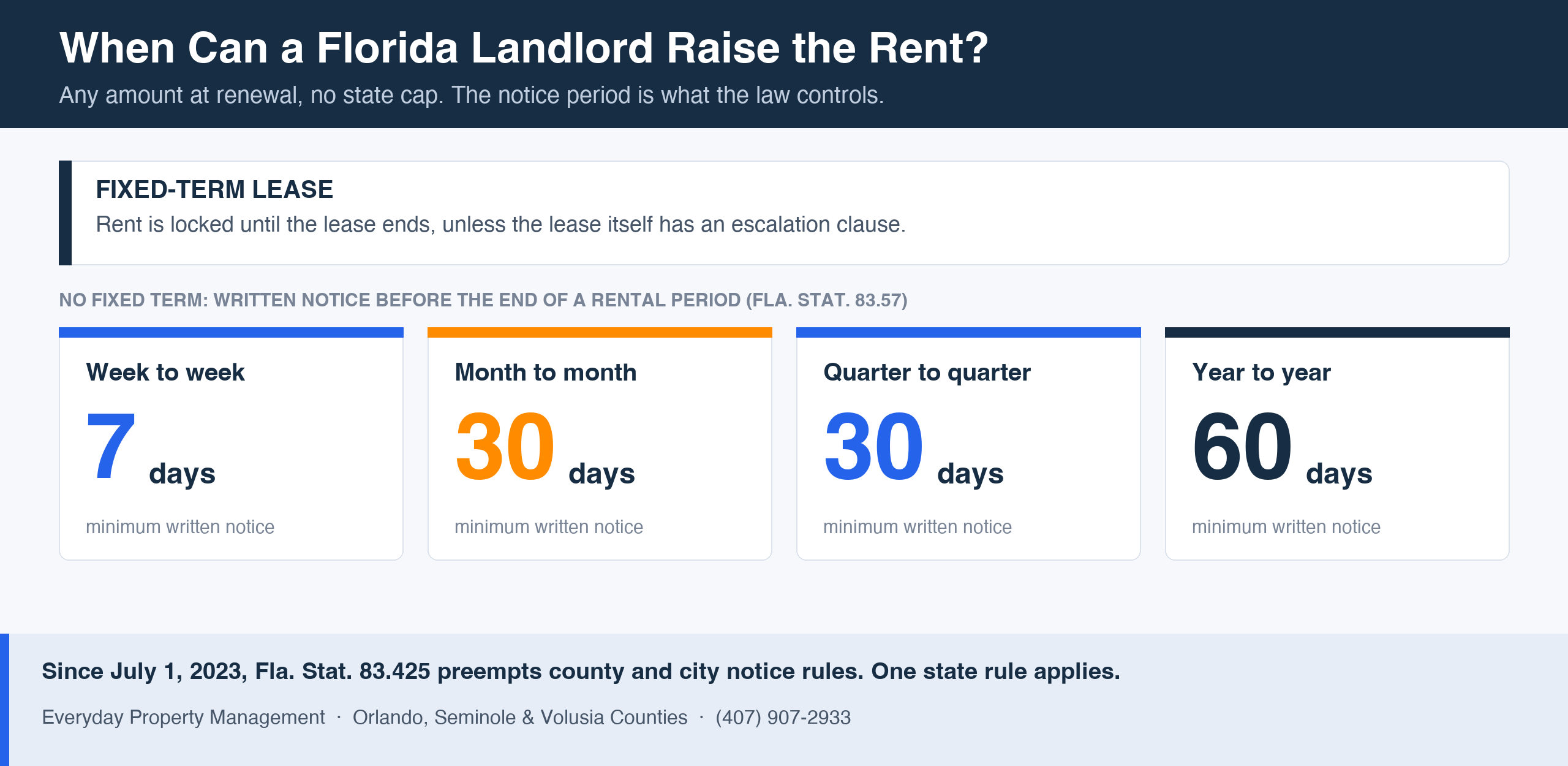
Not during a fixed-term lease, unless the lease contains an escalation clause. At renewal or on a month-to-month tenancy you can raise it by any amount — Florida sets no cap — but you cannot simply impose the new rent. On a month-to-month tenancy you end the old one with at least 30 days’ written notice before the end of a monthly period (Fla. Stat. 83.57(3)) and offer to continue at the new rate.
During the lease, the rent is locked
A signed lease fixes the rent for its full term. Unless the lease itself contains an escalation clause that both parties agreed to at signing, you cannot raise the rent mid-term — not for rising insurance, not for a tax increase, not for anything. The lease is the whole answer.
This is the single most common mistake self-managing owners make, usually in good faith after an insurance renewal lands badly. The place to solve that problem is the next lease, not this one.
At renewal or month-to-month: no cap, but notice
Florida has no rent control and no legal ceiling on an increase. State law goes further and preempts cities and counties from adopting rent control of their own, under Florida Statutes 125.0103 and 166.043. So the amount is a market question, not a legal one.
The timing is not. For a month-to-month tenancy, Florida Statute 83.57 requires at least 30 days’ written notice before the end of a monthly rental period. That was raised from 15 days in 2023, and notices still occasionally go out on the old timeline. Put it in writing, date it, and keep proof of delivery — a verbal heads-up is not notice.
County rules no longer apply, and that surprises people
Orange County used to require 60 days’ written notice for any increase above 5%, under its 2022 Rental Notices Ordinance. That rule has not been enforceable since July 1, 2023. Florida Statute 83.425, created by HB 1417, preempts local regulation of residential tenancies to the state and expressly supersedes local “notice requirements.” Orange County’s own Office of Tenant Services has confirmed the ordinance is unenforceable, and no citations were ever issued under it.
The practical effect for Central Florida owners is that Orange, Seminole and Volusia properties all follow the same state rule. There is no county patchwork left to track. Two things still override the statute in your favour: your own lease, if it promises the tenant more notice than the law requires, and any notice clause you agreed to under Fla. Stat. 83.575(1), which must be reciprocal and fall between 30 and 60 days.
Reasons you cannot raise the rent
An increase is unlawful if it is retaliation. Under Florida Statute 83.64, a landlord may not retaliate against a tenant for complaining to a code authority, requesting repairs, or joining a tenants’ organisation — and raising the rent counts. An increase landing shortly after a maintenance complaint invites that argument even when the timing is coincidental, so document your reasoning.
An increase also cannot be tied to race, colour, national origin, religion, sex, familial status or disability under the federal Fair Housing Act. Apply increases consistently across comparable units and the question never arises.
Setting the number, not just the date
Legality is the floor, not the strategy. An increase that pushes a reliable tenant out can cost more than it earns: a vacancy in Central Florida typically runs several weeks, and turnover brings make-ready costs, marketing, and a new placement fee. A $75 monthly increase gains $900 a year; one month vacant plus turnover can erase two years of that.
The better approach is to price against actual comparable rentals in your submarket, move in smaller and more regular steps rather than one large correction, and give a long-term paying tenant a reason to stay. Owners who reset to market every year rarely face the painful conversation at all.
Related Questions
- How is rental price determined for my property?
- How does rent collection work with a property manager?
- What happens when a tenant stops paying rent?
- How fast can a property manager fill a vacancy?
- Property Management Pricing in Central Florida
- What happens at the end of a lease term?
Talk to a Local Property Manager
Everyday Property Management prices renewals against live Orlando, Seminole County and Volusia County comparables and serves every notice on the right timeline for the right county. Call (407) 907-2933 or send us a message below.
This page is general information, not legal advice. Talk to a Florida attorney about your situation. Last reviewed against the Florida Statutes on September 17, 2026.