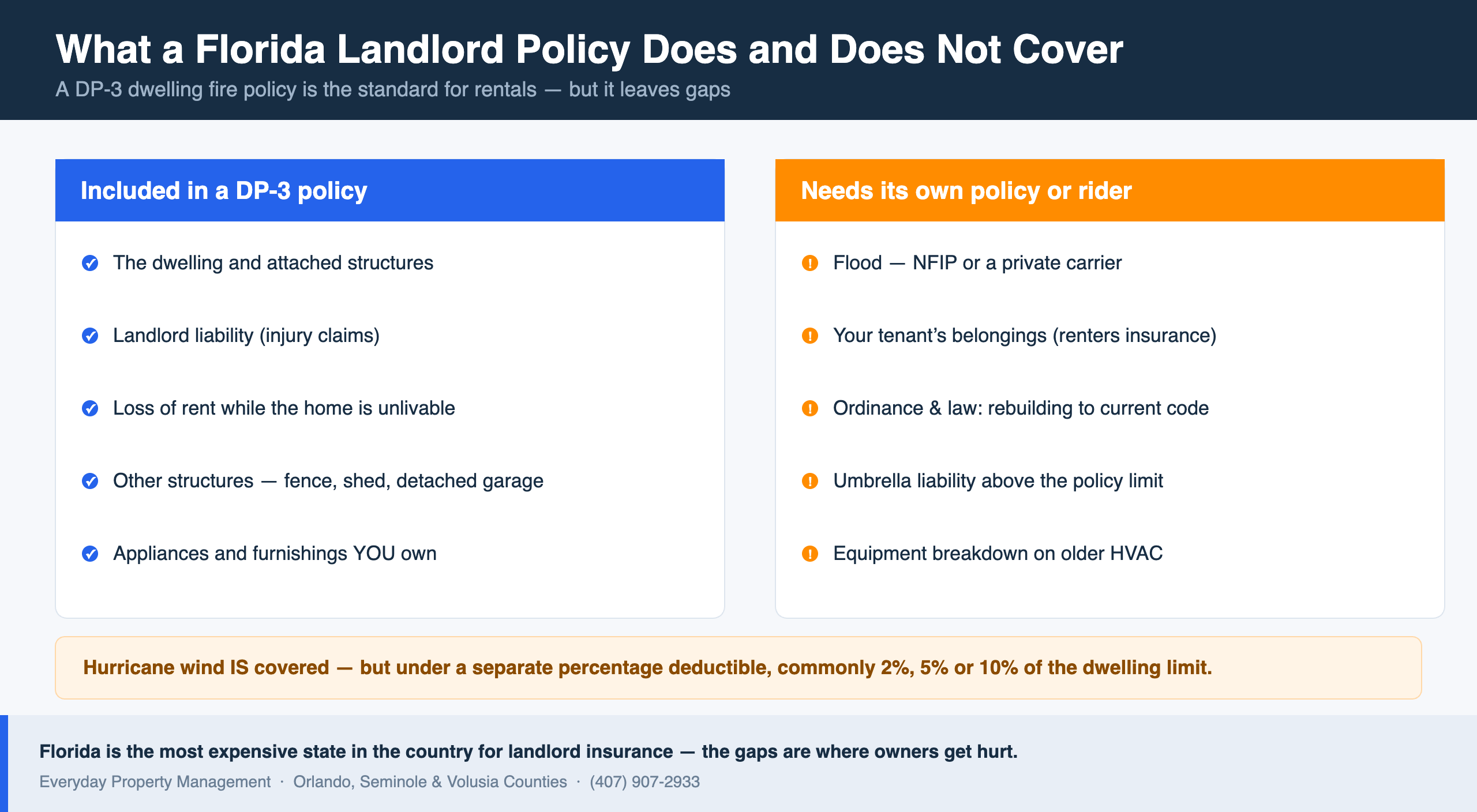
A landlord policy — usually a DP-3 dwelling fire form — covering the building, your liability, and lost rent while the home is unlivable. In Florida, plan separately for two things it won’t fully handle: flood, which needs its own NFIP or private policy, and hurricane wind, which carries a percentage deductible.
Your homeowner’s policy will not cover a rental
The moment a tenant moves in, the occupancy changes and a standard HO-3 homeowner’s policy stops matching the risk. Carriers can deny a claim on that basis alone. What replaces it is a dwelling fire policy, and for most single-family rentals that means the DP-3 form — open-peril, usually replacement cost, and built to include liability and loss of rent.
Tell your insurer the property is tenant-occupied before the first lease starts, not after the first claim.
The four coverages that actually matter
Dwelling. Enough to rebuild, not what you paid. Construction costs and the purchase price move independently.
Liability. Covers an injury claim from a tenant or their guest. $300,000 is common; $500,000 to $1 million is cheap for what it buys.
Loss of rent. Pays your rental income while the home is uninhabitable after a covered loss. Owners skip this and then discover a four-month rebuild means four months of mortgage with no rent behind it.
Other structures and owner-supplied contents. Fences, sheds, detached garages, and the appliances and window treatments you provide.
Florida’s two hard parts: wind and flood
Hurricane wind is covered, but separately deductible. Named-storm damage runs through its own percentage deductible — commonly 2%, 5% or 10% of the dwelling limit rather than a flat dollar amount. On a $400,000 dwelling limit, a 5% deductible is $20,000 out of pocket before the policy pays anything. Know your percentage before June.
Flood is never included. Every dwelling fire form excludes it. Flood requires a separate policy through the NFIP or a private carrier. Roughly a quarter of flood claims come from outside high-risk zones, so “my lender doesn’t require it” is not the same as “I don’t need it.”
If the private market declines you, Citizens Property Insurance is the state-backed insurer of last resort and does write DP-3 policies, subject to dwelling caps.
What to require from your tenant
Your policy does not cover a single thing your tenant owns. Require renters insurance in the lease with a minimum personal liability limit, and ask to be named as an interested party so you are notified if the policy lapses. It costs the tenant very little and it stops their loss from becoming an argument with you.
What this looks like in Orlando, Seminole and Volusia
Central Florida owners sit in an odd middle. Inland Orange and Seminole County properties are far from storm surge, which tempts owners to skip flood entirely — but the 2022 storms put water into plenty of homes that had never taken any, driven by rainfall and drainage rather than the coast. Volusia adds genuine coastal exposure on top.
Check your address on FEMA’s flood map, then price a preferred-risk NFIP policy anyway if you are in an X zone. It is usually a few hundred dollars, and it is the cheapest coverage you will ever buy on a rental.
Related Questions
- Who pays for repairs in a managed rental property?
- What is a reasonable maintenance reserve for a rental?
- What records should a landlord keep for taxes?
- What’s included in a property management agreement?
- Property Management Services in Central Florida
- Do I need an LLC for my rental property?
Talk to a Local Property Manager
We do not sell insurance — but we do see which policies actually pay when a claim lands. Everyday Property Management helps Orlando, Seminole County and Volusia County owners document their properties properly so claims go smoothly. Call (407) 907-2933 or send us a message below.
This page is general information, not insurance advice. Talk to a licensed Florida agent about your property.