Nothing happens automatically — Florida requires a paper trail. Your manager serves a written 3-day notice demanding the rent or possession of the property, counting only business days. If the tenant still does not pay, an eviction is filed in county court. Only a judge and the sheriff can remove a tenant; never change the locks.
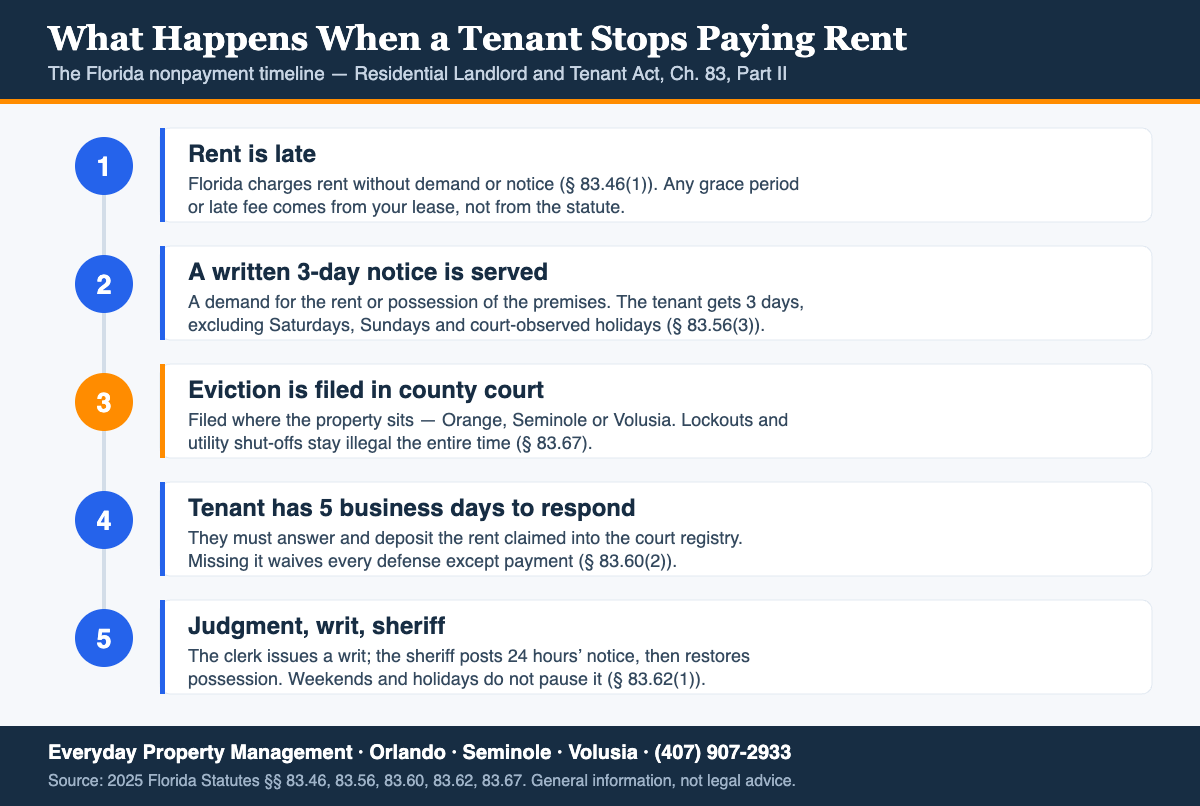
The Florida Nonpayment Timeline, Step by Step
Late rent is not, by itself, an eviction. Florida’s Residential Landlord and Tenant Act lays out a sequence, and skipping a step is the most common reason a nonpayment case gets dismissed and has to start over.
Day one: the rent is simply late. Section 83.46(1), Florida Statutes, provides that unless otherwise agreed, rent is payable without demand or notice. There is no statutory grace period and no statutory late fee — both come from your lease. In practice this is where a manager earns the fee: a call, a documented conversation and sometimes a short payment plan resolve most late rent before anything legal begins.
The three-day notice. Under section 83.56(3), if the tenant fails to pay rent when due and the default continues for 3 days — excluding Saturday, Sunday and legal holidays — after delivery of a written demand for the rent or possession of the premises, the landlord may terminate the rental agreement. The statute limits “legal holidays” to court-observed holidays only, prescribes the wording, and requires the notice to state the exact sum owed and the address of the premises including the county. Section 83.56(4) permits delivery by mail, by hand, by leaving a copy at the residence if the tenant is absent, or by e-mail under section 83.505 — and provides that these notice requirements may not be waived in the rental agreement.
Partial payments need care. Section 83.56(5)(a) confirms that accepting partial rent does not waive the right to terminate — but only if the landlord then gives the tenant a dated receipt stating the balance due before filing, places the partial rent in the court registry on filing, or posts a fresh three-day notice for the new amount.
Filing. If the notice expires unpaid, the eviction is filed in county court in the county where the property sits. From here the case is about procedure, not about your lease.
The tenant’s five days. Section 83.60(2) requires a tenant who raises any defense other than payment — including a defective three-day notice — to pay the accrued rent alleged in the complaint into the registry of the court. Failing to do that, or to file a motion to determine the amount, within 5 days excluding Saturdays, Sundays and legal holidays after service of process is an absolute waiver of every defense but payment, and the landlord is entitled to an immediate default judgment for removal with a writ of possession.
Judgment and the writ. Under section 83.62(1), after judgment for the landlord the clerk issues a writ commanding the sheriff to put the landlord in possession after 24 hours’ notice conspicuously posted on the premises — and Saturdays, Sundays and legal holidays do not stay that 24-hour period.
What You Cannot Do, Even When You Are Owed Money
Self-help is where otherwise reasonable owners get hurt. Section 83.67 prohibits a landlord from causing the termination or interruption of any utility service, from preventing the tenant’s reasonable access by changing the locks or using a bootlock, and from removing doors, locks, roof, walls, windows or the tenant’s personal property outside a lawful eviction. A landlord who violates the section is liable to the tenant for actual and consequential damages or three months’ rent, whichever is greater, plus costs and attorney’s fees, and separate violations can draw separate awards. A one-month rent problem becomes a three-month rent problem the moment the locks change.
Getting Paid After the Tenant Is Gone
Possession and money are two separate questions. Where service of process was properly effected, section 83.625 directs the court in a nonpayment action to enter a money judgment with costs for the amount found due in addition to awarding possession, with attorney’s fees available to the prevailing party. Section 83.595 then sets your options once there is a writ, a surrender or an abandonment: treat the agreement as terminated and retake possession for your own account, ending the tenant’s further liability, or retake for the tenant’s account and hold them liable for the difference between the lease rent and what a reletting recovers. The second route carries a duty to act in good faith in attempting to relet, and any agreed liquidated damages or early termination fee may not exceed two months’ rent.
The security deposit runs on its own clock: section 83.49(3) gives you 30 days after termination to send written notice of your intent to impose a claim, and missing that deadline forfeits the right to claim against the deposit at all.
When a Tenant Stops Paying Rent in Orlando, Seminole and Volusia County
Central Florida makes this a seasonal problem as much as a legal one. Hospitality, theme parks and construction drive local household income, so a cut in hours shows up in the rent roll before it shows up anywhere else — and after a named storm, displaced tenants and disrupted pay cycles arrive together.
Venue is county-specific. A residential nonpayment action is filed in county court where the property sits — Orange, Seminole or Volusia — and each clerk has its own rhythm for issuing summonses and writs, so a manager who files in your county regularly simply moves faster. Ask who signs and serves the notice, too: a defective three-day notice usually means serving a correct one and restarting the clock.
If you are comparing property management companies near me and every proposal promises to “handle delinquencies,” ask four concrete questions instead: on what day is a three-day notice served, who signs it, which attorney files the eviction, and what does it cost me. At Everyday Property Management, full management is 8% of monthly rent, tenant placement is half a month’s rent with a 12-month tenant guarantee, and lease renewals are free.
Related Questions
- How does rent collection work with a property manager?
- How do property managers screen tenants?
- What’s included in a property management agreement?
- Who pays for repairs in a managed rental property?
- Our Central Florida property management services
- Do property managers handle evictions?
- How do security deposits work in a managed property?
- When can a landlord raise the rent?
- Our Florida 3-day notice service
- Our eviction coordination with counsel
Worried About a Tenant Who Has Stopped Paying?
Send us the property address and the date rent was last received, and we will walk you through exactly what the next 30 days would look like on your home — when the three-day notice goes out, who serves it, what filing in your county involves, and what it costs. Call (407) 907-2933 or use the form below.
General information for Florida rental owners, not legal advice. Statute references are to the 2025 Florida Statutes; for a specific lease or nonpayment case, speak with a Florida attorney.