Your tenant pays the property manager, not you. Rent is due on the date the lease names, paid through an online portal, deposited into the brokerage escrow account, and remitted to you on a fixed date each month with a statement showing rent collected, fees charged and any repairs paid.
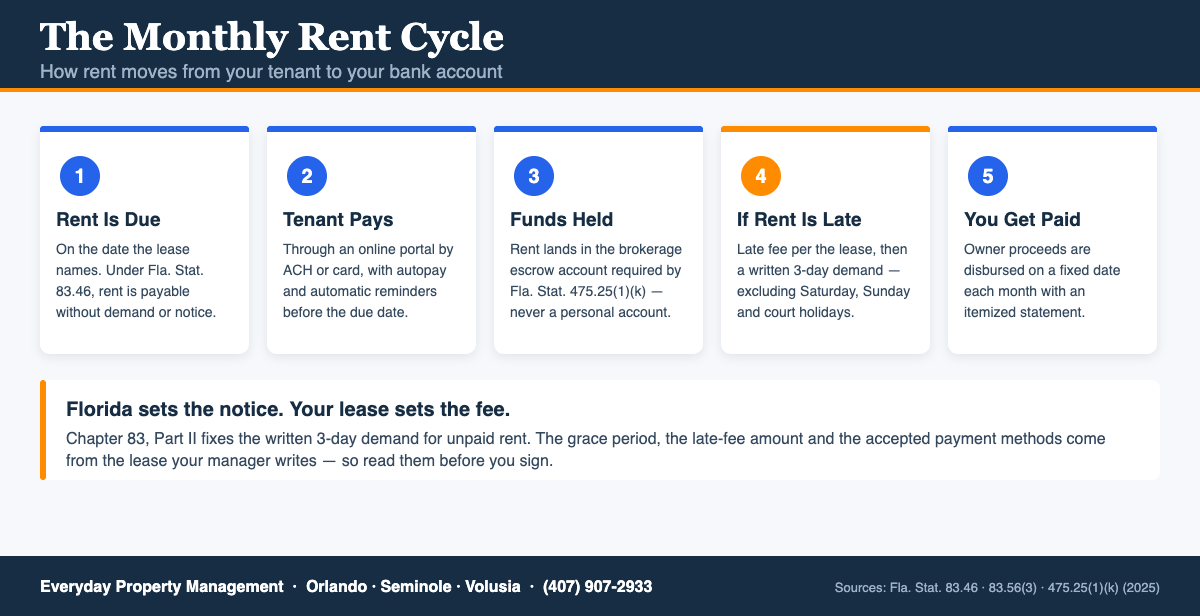
The Rent Cycle, Step by Step
Handing rent collection to a property manager changes three things: who your tenant pays, how they pay, and what happens when they do not. The mechanics are broadly the same at every licensed Florida brokerage, and they run on a monthly loop.
- Rent is due on the date in the lease. Section 83.46(1), Florida Statutes, provides that unless otherwise agreed, rent is payable without demand or notice and periodic rent is payable at the beginning of each rent payment period. No reminder is legally owed — a good manager sends several anyway.
- The tenant pays the brokerage, not you. Payments run through a tenant portal by ACH, debit or card, usually with autopay available. Your name, address and bank details stay out of the transaction.
- Everything posts to one ledger. Rent, late fees, prorated amounts, utility reimbursements and tenant chargebacks all land on a single account you can see in your owner portal.
- Funds sit in escrow. They are not the brokerage’s money and they are not sitting in someone’s business checking account.
- You are paid on a fixed date. Approved expenses come off, the reserve is topped back up, and the balance is sent to you with an itemized statement.
When Rent Is Late: What Florida Actually Requires
This is the part owners most want handled by someone else, and it is where the law is specific. Florida’s Residential Landlord and Tenant Act sets no late-fee amount and no mandatory grace period — those come from the lease your manager writes. What the statute controls is the notice.
Under section 83.56(3), Florida Statutes, if the tenant fails to pay rent when due and the default continues for 3 days after delivery of a written demand for the rent or possession of the premises, the landlord may terminate the rental agreement. Those 3 days exclude Saturday, Sunday and legal holidays, and the statute narrows “legal holidays” to court-observed holidays only. The notice has a prescribed form, it must state the exact sum owed and the address of the premises including the county, and under section 83.56(4) the notice requirements may not be waived in the rental agreement.
Delivery matters as much as timing. A three-day notice may be mailed, hand-delivered, left at the residence if the tenant is absent, or — since 2025 — e-mailed under section 83.505. That e-mail route is narrower than it sounds: it requires a signed addendum in which both parties specifically agree to electronic delivery and supply e-mail addresses, the addendum must say the election is voluntary and revocable, the notice is deemed delivered when sent unless it bounces, and the sender must keep both a copy and evidence of transmission. Ask whether your manager uses it and how they document it.
Partial payments are the classic trap. Section 83.56(5)(a) confirms that a landlord does not waive the right to terminate by accepting partial rent — but only if the landlord then provides a dated receipt stating the balance due before filing for possession, places the partial rent in the court registry on filing, or posts a fresh three-day notice for the new amount. A manager who takes half the rent and skips that step has just weakened your case.
Where Your Money Sits — and When It Reaches You
Because managing rentals for an owner is brokerage activity in Florida, your rent is escrow money. Section 475.25(1)(k), Florida Statutes, requires a broker to immediately place, upon receipt, any money entrusted to them in escrow with a title company, banking institution, credit union or savings and loan located and doing business in this state, where it is kept until disbursement is properly authorized. Ask which institution holds it and get the answer in writing.
Then pin down the calendar. “Owner proceeds are remitted by the 10th” is a term you can hold someone to; “funds are disbursed monthly” is not. Your statement should show gross rent collected, the management fee, any maintenance paid, the reserve balance and the net sent to you — and the year-end summary plus your 1099 should reconcile to twelve of those statements. One more detail worth asking about: if the lease offers a fee in lieu of a security deposit under section 83.491, that recurring fee is payable on the same date as rent but it is not deposit money and it never becomes yours, so it should be reported separately on the ledger.
Rent Collection in Orlando, Seminole and Volusia County
Central Florida gives rent collection a rhythm of its own. A large share of local tenants work in hospitality, theme parks, healthcare and construction, where hours move with the season — which means the first week of a slow month is when a portal, a payment plan and an early phone call earn their keep. Storm season adds its own wrinkle: after a named storm the question is never only whether the roof held, but whether rent posts on time while people are displaced, and your manager should have a written position on that before September arrives.
Venue matters too. If a nonpayment case has to be filed, it goes to county court in the county where the property sits — Orange, Seminole or Volusia — and each clerk has its own filing rhythm. A manager who files regularly in your county will move faster than one who does not. If your home is in an HOA or condominium association, confirm who fields association fee questions so an association bill never gets confused with rent on the ledger.
If you have been comparing property management companies near me and every proposal promises “prompt rent collection,” ask four concrete questions instead: what date is rent due, what date do I get paid, who signs and serves the three-day notice, and what does the ledger look like. At Everyday Property Management, full management is 8% of monthly rent, tenant placement is half a month’s rent with a 12-month tenant guarantee, and lease renewals are free.
Related Questions
- What’s included in a property management agreement?
- How much does a property management company charge?
- What does a property manager actually do?
- Who pays for repairs in a managed rental property?
- Our Central Florida property management services
- When can a landlord raise the rent?
- What happens when a tenant stops paying rent?
- What records should a landlord keep for taxes?
- Online rent collection and owner deposits
Want Rent to Arrive on Time, Every Month?
Send us the property address and we will show you exactly how rent collection would run on your home — the due date, the portal, the late-fee policy, the notice process and the date your proceeds land, with a sample owner statement so you can see the ledger before you commit. Call (407) 907-2933 or use the form below.
General information for Florida rental owners, not legal advice. Statute references are to the 2025 Florida Statutes; for a specific lease or nonpayment case, speak with a Florida attorney.