Short answer: Yes — but only up to a point. In Florida a property manager serves the 3-day or 7-day notice, documents the default, files the eviction and handles the turnover. Once a tenant contests the case or the owner is an LLC, a licensed attorney must take it from there. Most managed evictions never reach a courtroom.
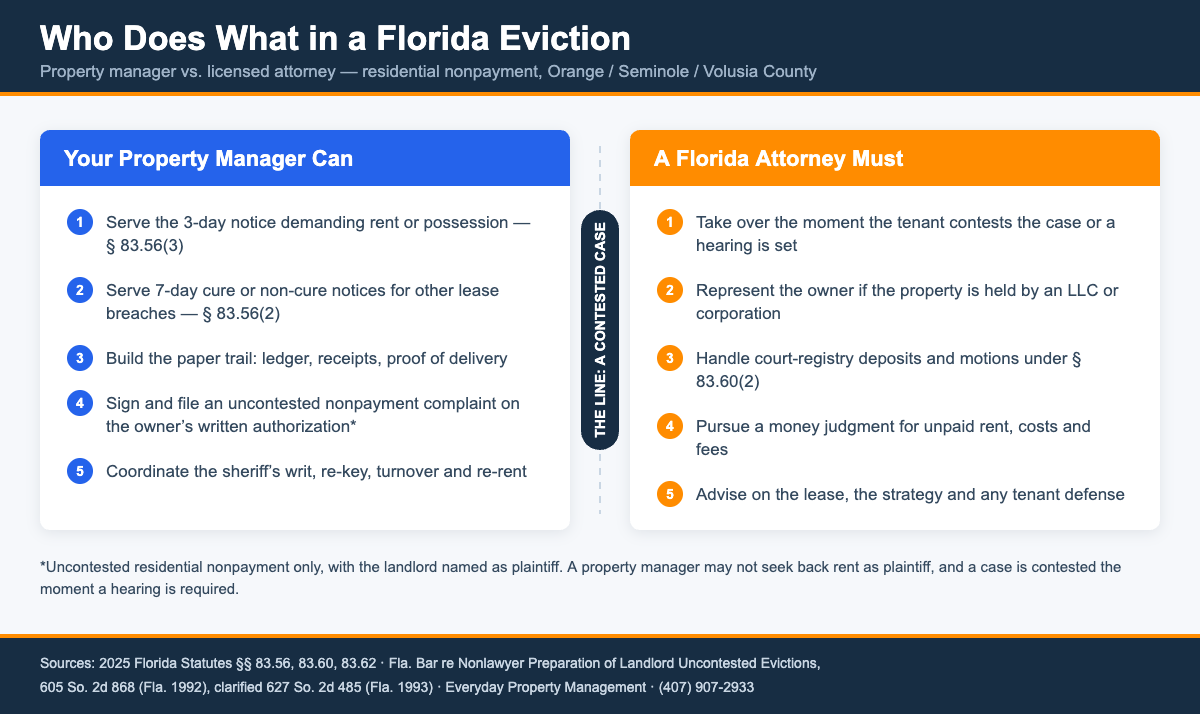
What Your Property Manager Actually Does in an Eviction
Most of an eviction is not courtroom work, and that part belongs squarely to your manager. Under section 83.56(3), Florida Statutes, a nonpayment case begins with a written demand for the rent or possession of the premises, giving the tenant 3 days excluding Saturday, Sunday and legal holidays — and the statute limits those to court-observed holidays only. It prescribes the wording and requires the exact sum owed plus the address of the premises, including the county. Section 83.56(2) covers everything that is not rent: a 7-day notice to cure for curable breaches such as unauthorized pets, guests or vehicles, or a 7-day notice of termination for conduct the tenant should not be given a chance to cure. Getting the right notice served on the right day is the single most common place a case falls apart, and it is a management job.
Around the notice sits the rest of the work: a rent ledger that ties out, dated receipts for any partial payment, proof of how and when the notice was delivered, photographs, and a record of every conversation. By the time a case is filed, that file is the case. Afterward your manager coordinates the sheriff’s writ, meets the deputy, re-keys the home, deals with anything left behind, turns the unit and re-rents it.
Where the Line Is — Filing, Hearings and the Unauthorized Practice of Law
Florida lets a nonlawyer manager go further than most states do. In The Florida Bar re: Advisory Opinion — Nonlawyer Preparation of Landlord Uncontested Evictions, 605 So. 2d 868 (Fla. 1992), clarified at 627 So. 2d 485 (Fla. 1993), the Supreme Court of Florida authorized nonlawyer property managers to complete, sign and file complaints for eviction and motions for default, and to obtain final judgments and writs of possession, in uncontested residential nonpayment cases.
The limits are strict. The landlord — not the manager — must be named as plaintiff, and the complaint is signed by the manager as “property manager for the plaintiff.” The manager must attach the landlord’s written authorization, and that authorization cannot designate the manager as plaintiff or authorize the manager to seek recovery of past due rent. Most importantly, a residential eviction is deemed contested the moment a hearing is required; from that point the owner must appear personally or through an attorney. Anything past that narrow filing role is the unauthorized practice of law.
So the honest answer to “does my property manager handle the eviction?” is that a good one handles all of it except the parts a nonlawyer legally cannot — and keeps an eviction attorney on call for those.
If Your Rental Is Owned by an LLC, the Rules Change
This one catches owners out. A corporation or LLC is a separate legal person and generally cannot represent itself in court; outside of small claims, a Florida attorney must appear for it. Evictions are filed in county court, so if the deed is in your LLC’s name the nonlawyer filing route is closed from the start and the case goes to counsel on day one. That costs a little more and removes a real risk: an eviction complaint signed for an LLC by a nonlawyer can be treated as a nullity and dismissed, leaving you to restart the clock.
What an Eviction Costs in Orange, Seminole and Volusia County
Budget for the case, not just the lost rent. The Orange County Clerk of Courts publishes a $185 county civil filing fee, $10 per summons issued, $40 per defendant served by the Orange County Sheriff’s Office, and $90 for the writ of possession. Seminole and Volusia clerks work from the same statutory schedule with their own service and writ pricing through their sheriffs. Add attorney’s fees wherever counsel is required, and add the vacancy while the unit turns.
Local practice matters as much as the fee schedule. Individual circuits publish their own administrative orders governing nonlawyer eviction filings, clerks package their own forms, and each sheriff has its own rhythm for serving summonses and posting writs — so a manager who files in your county every month simply moves faster than one who does not.
If you are comparing property management companies near me on how they handle delinquency, ask four concrete questions: who serves the notice and on what day, which attorney do you file through, who fronts the filing fee, and what happens to my management fee while the home sits empty. At Everyday Property Management, full management is 8% of monthly rent, tenant placement is half a month’s rent with a 12-month tenant guarantee, and lease renewals are free.
Related Questions
- What happens when a tenant stops paying rent?
- How does rent collection work with a property manager?
- How do property managers screen tenants?
- What’s included in a property management agreement?
- Our Central Florida property management services
- How do security deposits work in a managed property?
- How fast can a property manager fill a vacancy?
- How is rental price determined for my property?
- Our Florida 3-day notice service
- Our eviction coordination with counsel
Facing a Delinquent Tenant? Let’s Look at the Actual File
Send us the property address, the date rent was last received and how the home is titled, and we will tell you exactly what the next 30 days look like — which notice goes out, who serves it, whether your case can be filed without an attorney, what your county charges, and what it costs you. Call (407) 907-2933 or use the form below.
General information for Florida rental owners, not legal advice. Statute references are to the 2025 Florida Statutes; for a specific lease or eviction, speak with a Florida attorney.